
Autor: NTA Time: 2026-07-25 08:55:02 Click:
AI-assisted inspection can reduce avoidable rental car damage disagreements by creating comparable checkout and return records, organizing candidate differences, and routing material exceptions to a named human reviewer.
A customer returns a rental vehicle after hours, and the next shift notices a new mark on a door. The checkout file contains a few phone photos, while the return file uses a different angle and lighting. Both sides may be looking at real evidence, yet the records are difficult to compare. This article explains how paired baselines, structured findings, human review, and clear communication make that review more consistent. AI vehicle damage inspection can reduce avoidable rental car damage disputes by creating one standardized condition record at checkout and another at return for the same vehicle. The system organizes candidate differences and their source images, while a named person reviews material exceptions under the operator's approved process. Four conditions make the comparison useful: • Both checkpoints use the same configured capture routine and coverage. • Each record is bound to vehicle identity, time, location, and a distinct inspection event. • Candidate differences are mapped to defined body areas and linked to source images. • A human reviewer evaluates exceptions before the operator communicates an outcome. Elscope Vision's arch scanner supports automated body-surface capture and report-based marking of defect locations and severity. Its role in this workflow is to make the two observations more comparable, not to determine how or when a difference occurred. The checkout record establishes the documented starting condition. It should be completed before the vehicle leaves the controlled handover area and before later activity can blur the sequence. A practical baseline contains: • The vehicle identifier used by the rental operation. • The rental or movement reference used to retrieve the event. • The checkout date, time, location, and inspection-event ID. • The configured body-surface image set and capture-quality status. • Existing findings mapped to body areas with supporting images. • A note when a required view is incomplete or needs manual follow-up. These fields are operational recommendations, not universal legal requirements. Each rental operator should align its record with current contracts, local procedures, and applicable rules. The return record is valuable only when it can be compared with the checkout baseline. Switching camera positions, omitting a panel, or attaching the wrong vehicle identifier can create a false appearance of certainty. The return workflow should follow a stable sequence: 1. Match the vehicle to the intended rental and inspection event. 2. Capture the same configured body areas used at checkout. 3. Record the return date, time, location, and event ID. 4. Check capture quality before the vehicle leaves the review area. 5. Compare the return evidence with the checkout baseline. 6. Route new or changed findings to a named human reviewer. 7. Preserve the review decision and the evidence used. If a required view is missing, the record should show that limitation. An incomplete capture should trigger a rescan or manual follow-up instead of appearing as a clean result. A damage map gives the comparison a common vocabulary. It places a candidate dent, scratch, or other visible exception on a defined body area instead of leaving the reviewer to interpret unrelated notes. The European Car Rental Conciliation Service evidence guidance asks for photographs from pick-up and drop-off and recommends retaining original files with time and date metadata where possible. That guidance illustrates why both sides of the rental need retrievable source evidence, not only a final summary. AI can flag candidate differences and organize the related images. It cannot establish cause from two condition records, and it should not make the operator's final exception decision. The NIST AI Risk Management Framework Core recommends documenting system limitations and defining roles for human oversight. Applied to a rental workflow, that means naming the reviewer, defining what triggers escalation, preserving source evidence, and recording overrides or rescans. Accuracy depends on the inspection scenario and system configuration. Coverage also depends on the selected modules and workflow. Material findings therefore remain subject to human review in context. Fair communication starts with the shared evidence. Staff can display the checkout and return views together, identify the body area that changed, and explain that the finding has entered the operator's review process. The conversation should stop short of asserting cause. A structured condition report supports a more specific discussion, but it does not guarantee agreement or remove the need for an established customer-review channel. The same principle applies when the evidence is incomplete. Telling the customer that a view was unavailable and that further review is required is more transparent than presenting an uncertain comparison as final. Elscope Vision's official product page states that the arch scanner supports API docking, local server deployment, remote access, and traceability. Those are product-level capabilities, not proof of compatibility with a particular rental platform. Procurement teams should verify: • Which vehicle, rental, event, and location identifiers can be received and returned. • Which source images and mapped findings appear in the report and export. • How permissions limit access to customer and vehicle records. • How incomplete captures, mismatched identifiers, and unavailable services are handled. • How long records remain available under the selected configuration. • Whether a reviewer can reopen both checkpoints without relying on a local explanation. The answers should be demonstrated against the rental operator's own checkout and return process. No integration, field map, retention setting, or retrieval behavior should be assumed from a generic demonstration. No. It can document the condition observed at two inspection events and highlight candidate differences. Establishing cause requires context beyond the image comparison. No. Automation standardizes capture and organizes candidate findings. A named human reviewer still evaluates material exceptions under the operator's approved procedure. Both records need the same vehicle identity, comparable coverage, checkpoint context, capture-quality status, and retrievable source images. A missing baseline or unmatched view weakens the comparison. The official Elscope Vision page states that API docking is supported. Buyers should validate the exact fields, formats, permissions, error handling, and retrieval workflow for the selected configuration and rental platform. A useful pilot follows one vehicle from checkout through return, introduces a known exception, and asks a reviewer who was not present at either checkpoint to reconstruct the record. Contact the Elscope Vision team to test your own identifiers, capture coverage, exception rules, and condition-report requirements.Paired records reduce avoidable disagreement

Create the checkout baseline before handover
Repeat the same capture at return
Make every candidate difference reviewable
Record element What it should contain Why it matters Vehicle binding approved vehicle identifier and rental reference connects both events to the same vehicle and movement Event context checkout or return stage, date, time, location, and event ID places each record at a defined checkpoint Capture evidence configured images and capture-quality status shows what was actually available for review Damage map body area, candidate exception type, severity band, and source image makes the two records easier to compare Review trail reviewer, decision, evidence reference, and follow-up status records how an exception was handled 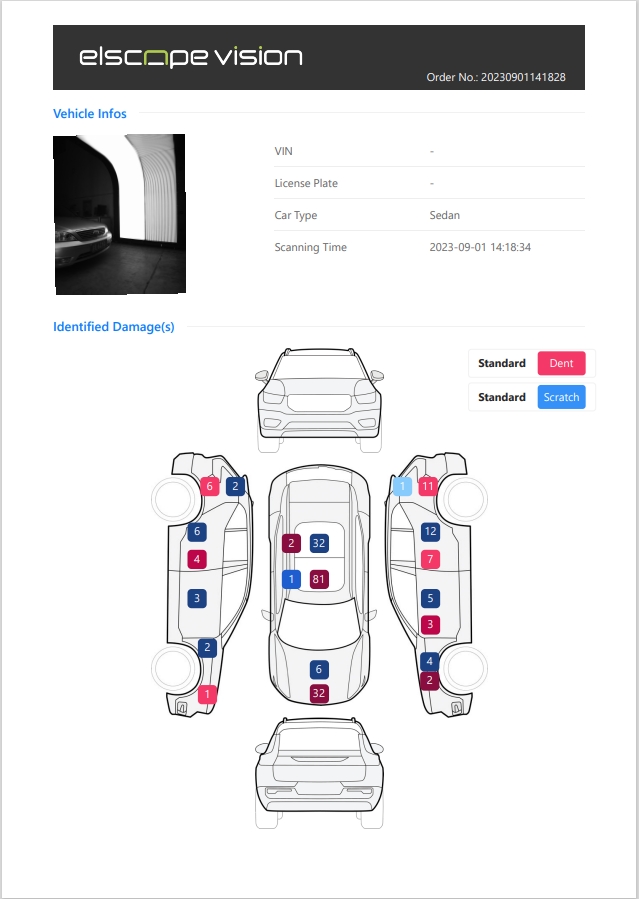
Keep detection separate from adjudication
Communicate what the records show
Validate reports, exports, and access before deployment
Common questions
Can AI inspection prove when rental vehicle damage occurred?
Does automated inspection replace a return agent?
What makes a checkout and return comparison reliable?
Can the report connect to a rental management system?
Test the evidence trail with a real rental workflow
Let's Discuss Your Inspection Needs
We offer professional consultation services
Address : NO. 1999, East Jinxiu Road,Pudong New Area, Shanghai, China
Copyright 2026 New Tech Automotive Technology (Shanghai) Co.,Ltd. All Rights Reserved Information Security
Follow Us


Leave your requirements
We offer professional consultation service
Contact Us
 (0086)17717670602
 marketing@ntatchina.com
 8617717670602
Follow Us
Address : NO. 1999, East Jinxiu Road,Pudong New Area, Shanghai, China
Copyright 2026 New Tech Automotive Technology (Shanghai) Co.,Ltd. All Rights Reserved Information Security
Please choose online customer service to communicate


