
Autor: NTA Time: 2026-07-25 09:19:58 Click:
AI-assisted tire inspection can support more disciplined fleet maintenance by creating repeatable tread and sidewall records, preserving trends, and routing exceptions to human reviewers. Cost impact must be evaluated against the fleet's own baseline.
A tractor returns to a depot with a steer tire measured several weeks earlier, but the reading exists only on a clipboard. Another yard uses a different gauge and records a different groove, so the two numbers cannot support a reliable trend. Maintenance teams then have to decide whether to inspect, rotate, align, or replace without a consistent record. This guide explains the system capabilities that improve tire-health tracking, how they fit into a maintenance workflow, and why any cost claim still needs a fleet-specific baseline. AI vehicle inspection systems can support fleet maintenance by making tire measurements more repeatable, binding them to the correct vehicle and inspection event, and keeping the resulting history available for review. They do not guarantee lower costs, predict every tire outcome, or replace the judgment of qualified maintenance personnel. The most useful capability stack usually includes: • Drive-over tread measurement for repeatable readings across commercial wheel positions. • Sidewall imaging and identification when the selected configuration includes that module. • Vehicle, time, location, and event binding so one reading can be compared with the next. • Trend records, alerts, reports, and export options that fit the fleet's review process. • Human adjudication for unreadable captures, unusual wear, and maintenance decisions. Elscope Vision's commercial inspection solution offers these functions as separate modules that can be configured for a site. LUBAN MAX covers commercial drive-over tread measurement, while the tire sidewall scanner adds sidewall images, identification, and visible-condition analysis. LUBAN MAX is the commercial-vehicle drive-over tread scanner in the Elscope Vision range. The official product page states that it measures all grooves of each tire in one pass and supports multi-wheel, multi-axle trucks. The current official brochure lists The product page also lists report outputs for tire wear, eccentric wear, gnawed-tire conditions, replacement alerts, wheel-alignment suggestions, and abnormal-condition warnings. These outputs can help a reviewer find records that need attention. They should be treated as decision support, not as automatic replacement or maintenance decisions. Tread depth answers only part of a tire-health question. A fleet may also need to identify the tire and preserve visible sidewall evidence for the same inspection event. The official tire sidewall scanner page lists: • Detailed reports with 4K tire images. • Tire size, brand, and age information. • OCR for tire brand, model, and age. • AI recognition of sidewall and wheel conditions such as bulges. • Cloud access and API support for configured data workflows. These capabilities belong to the sidewall module. A tread-only deployment should not be described as providing them automatically. Buyers should confirm the exact camera coverage, fields, access controls, retention policy, and export format in the proposed configuration. No single system type fits every depot. The right choice depends on where inspections happen, what evidence is missing, and how exceptions are reviewed. An integrated commercial lane can combine tread, sidewall, underbody, and exterior modules when those components are included in the project. Its scope should be verified from the actual bill of materials rather than inferred from the solution name. A useful system does more than produce a scan. It connects inspection evidence to a maintenance decision and preserves the result for the next review. 1. Bind the inspection to the approved vehicle or fleet identifier. 2. Record the date, time, location, inspection event, axle, and wheel position. 3. Capture tread measurements using the configured commercial workflow. 4. Add sidewall identification and visible-condition evidence when that module is present. 5. Compare the record with the same wheel position's prior observations. 6. Route threshold breaches, unreadable captures, and unusual patterns to a named human reviewer. 7. Record the approved action, such as manual inspection, rotation review, alignment check, replacement review, or rescan. 8. Preserve the outcome so the next inspection can be interpreted in context. The fleet should define its own thresholds from current rules, tire policy, vehicle duty, and qualified maintenance guidance. A system alert is not enough by itself to prove a tire's cause of wear, remaining service life, or required action. Better records may reduce avoidable information gaps in maintenance planning. For example, a consistent history can help teams identify which records require physical inspection and whether an observed wear pattern is new or recurring. That does not prove a cost reduction. A credible evaluation needs a defined baseline, representative vehicles, the same decision rules before and after deployment, and a review window long enough to observe maintenance outcomes. The fleet should measure its own indicators, such as record completeness, exception-review rate, follow-up completion, and agreement between system findings and qualified physical inspection. Procurement teams should also test data ownership, record retrieval, role permissions, export format, and API behavior. A technically capable scanner can still fail operationally if the maintenance team cannot retrieve the evidence or connect it to the existing asset record. The current official brochure lists No verified source supports a universal prediction guarantee. The system can organize measurements, trends, alerts, and images for review, while qualified personnel decide what physical inspection or maintenance action is appropriate. No. Sidewall size, brand, age, image, and candidate-condition functions come from the separate tire sidewall scanner when it is configured. A tread-only installation should be evaluated as a tread-measurement workflow. Yes. A controlled lane can handle repeatable depot checks, while handheld and manual methods can support satellite locations, inaccessible areas, and exception adjudication. The important requirement is that every method preserves vehicle identity, wheel position, inspection context, and the reviewer-owned outcome. Fleet tire-health tracking improves when each reading is repeatable, tied to the correct asset, and carried through to a human-owned maintenance outcome. The appropriate Elscope Vision configuration depends on the fleet's vehicle mix, checkpoint design, sidewall-evidence needs, and data workflow. Contact the Elscope Vision team to test representative vehicles and confirm the exact measurement, image, report, permission, and export requirements before deployment.Repeatable tire records support better maintenance decisions
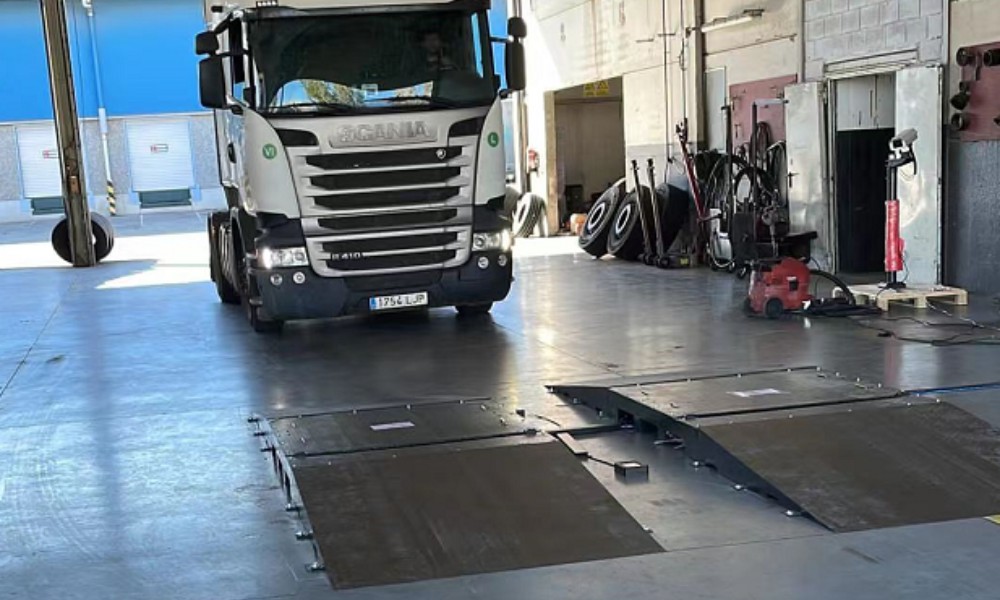
Use drive-over tread measurement for repeatable commercial records
0.3 mm measurement accuracy for the commercial-vehicle configuration. That figure is specific to the commercial configuration and should not be replaced with a specification from a passenger-car or handheld product.Add sidewall context when tread depth is not enough

Match the system type to the maintenance workflow
System capability Evidence created Best operational fit Human decision still required Commercial drive-over tread scanner per-tire groove measurements and wear-related report outputs repeatable checks at a controlled fleet lane verify unusual readings and choose the maintenance action Fixed sidewall scanner tire identity data, sidewall images, and candidate visible conditions fleets that need tread and sidewall context at the same checkpoint confirm the finding and decide whether physical inspection is needed Integrated commercial lane configured combination of tread, sidewall, underbody, and exterior evidence sites that want multiple inspection modules at one checkpoint review cross-module exceptions and approve follow-up Handheld tread scanner localized tread records for a selected vehicle or tire satellite yards, spot checks, and exception follow-up maintain a consistent sampling method and record the outcome Structured manual inspection direct physical observation and technician notes adjudication, inaccessible areas, and maintenance confirmation technician owns the final assessment and action Build a closed tire-health review loop
Evaluate cost impact with fleet data
Frequently asked questions
What tread-depth accuracy applies to LUBAN MAX for commercial vehicles?
0.3 mm accuracy for the commercial-vehicle configuration. The specification is scoped to that configuration and does not establish the accuracy of other scanner categories.Can AI vehicle inspection predict tire failure or replacement timing?
Does every tire inspection system include sidewall recognition?
Can a fleet use more than one inspection method?
Make the evidence usable before measuring savings
Let's Discuss Your Inspection Needs
We offer professional consultation services
Address : NO. 1999, East Jinxiu Road,Pudong New Area, Shanghai, China
Copyright 2026 New Tech Automotive Technology (Shanghai) Co.,Ltd. All Rights Reserved Information Security
Follow Us


Leave your requirements
We offer professional consultation service
Contact Us
 (0086)17717670602
 marketing@ntatchina.com
 8617717670602
Follow Us
Address : NO. 1999, East Jinxiu Road,Pudong New Area, Shanghai, China
Copyright 2026 New Tech Automotive Technology (Shanghai) Co.,Ltd. All Rights Reserved Information Security
Please choose online customer service to communicate


