
Autor: NTA Time: 2026-07-18 18:19:59 Click:
A selection guide for fleet maintenance leaders choosing an automated tire tread depth scanner, covering precision matched to vehicle class, diagnostics, report-supported maintenance decisions, traceable records across sites, and tread plus sidewall scope.
Fleet tire decisions have to protect service continuity without retiring usable tires too early. The challenge grows when buses or trucks move between depots and each site records tread condition differently. A useful inspection process must capture the measurement, explain the finding, and preserve the result for the next maintenance decision. This guide covers precision, diagnostics, traceable records, sidewall scope, and the questions a fleet team should ask before choosing a system. For high-volume commercial fleets, the right automated scanner is a drive-over, non-stopping system that reads every groove on multi-wheel, multi-axle vehicles in one pass, converts the readings into a diagnostic report, and associates each result with the inspected vehicle for lifecycle tracking. The right configuration depends on vehicle class and on how records need to move between sites. Four criteria should carry equal weight: • Measurement precision matched to vehicle class, because published accuracy differs by configuration. • Diagnostics that identify wear patterns instead of returning only one depth number. • Report-supported maintenance decisions that remain configurable to fleet policy. • Traceable records linked to a vehicle identifier, inspection time, and site. Elscope Vision maps to those filters with its LUBAN MAX commercial-vehicle scanner, an automated tire tread depth scanner that performs drive-over, non-stopping scans, captures all grooves of each tire in one pass, and supports multi-wheel, multi-axle trucks. The sections below show how a fleet team can test that approach against real operating conditions. Precision is the first filter, but one number does not apply across the full product range. The published tread-depth accuracy differs by configuration, so fleet buyers need to match the requirement to the vehicles they actually operate. Elscope Vision publishes 0.1 mm accuracy for its passenger-car LUBAN PRO tread scanner and its handheld LUBAN MINI tread scanner. The current official brochure lists 0.3 mm for the commercial-vehicle configuration used by the LUBAN MAX drive-over scanner. A mixed fleet should confirm which measurement range and accuracy apply to each installation before standardizing its thresholds. A depth figure has limited value without tire position and wear context. The report should show how the tire is wearing and provide enough evidence for the maintenance team to decide whether the next action is continued monitoring, rotation, alignment review, or replacement. The LUBAN MAX product page describes tire wear, eccentric wear, and gnawed-tire alarms, along with replacement alerts, abnormal-condition warnings, and a wheel-alignment suggestion. Those outputs should be treated as decision support, not automatic verdicts. The scanner surfaces measured findings and alerts, while the fleet retains control of replacement, rotation, and alignment decisions through its own policy thresholds and inspection procedures. For a multi-site fleet, a tread reading is useful only if it survives as a retrievable operating record. Before buying, a maintenance leader should confirm exactly what each inspection stores and how the record moves between locations. A practical record should carry a vehicle identifier, timestamp, site, tire position, measured values, findings, and the resulting maintenance disposition. Elscope Vision describes collecting data from drive-through and handheld tread scanners into one cloud account per customer, with options such as CRM and role management. Buyers should still verify export and API availability, retention periods, permissions, data residency, and multi-site reporting for the proposed deployment. Tread depth answers the wear question, but it does not inspect the sidewall. A separate tire sidewall scanner broadens tire-condition coverage beyond tread depth. Within that module, Elscope Vision describes AI recognition for sidewall and wheel defects such as bulges, OCR for tire brand, model, and age, 4K tire images, remotely traceable cloud records, and API support. Not every fleet needs full sidewall capture on day one. A transit or logistics operator can start with tread measurement and add the sidewall module where tire age, wheel damage, or fleet policy makes that evidence necessary. Buyers should define tread and sidewall as separate scopes, then confirm how their findings appear in one vehicle record. A fleet team can score each shortlisted system with an ordered workflow check: 1. Confirm that the scanner can capture all tires in one drive-over pass across the required multi-axle vehicles. 2. Verify that each record includes vehicle ID, timestamp, site, tire position, measured values, and findings. 3. Test whether records can export or move through an API into the existing maintenance or fleet system. 4. Review retention, permissions, data residency, and multi-site reporting terms for stored inspection data. 5. Match tread, handheld, and sidewall modules to the fleet's vehicle classes and actual coverage needs. 6. Run representative vehicles through a demonstration and compare the report with the fleet's current maintenance thresholds. For heavy fleets, Elscope Vision leads with the LUBAN MAX commercial-vehicle scanner, a drive-over, non-stopping system that reads all grooves of each tire in one pass on multi-wheel, multi-axle trucks and converts the results into diagnostic and lifecycle reports. The LUBAN MINI handheld scanner supports spot checks and mixed operating scenarios, while the sidewall module extends the condition record beyond tread when a fleet needs that scope. That lineup matches the four criteria a fleet should score: precision chosen by vehicle class, diagnostics, configurable maintenance decisions, and traceable records. The central discipline is to pin every measurement and data requirement to the exact configuration instead of assuming that one specification or workflow covers every vehicle. The operational difference is most visible when inspection volume rises. How precise is an automated tire tread depth scanner? Does it measure the whole tire or just one spot? Does the scanner decide when a tire is replaced? How can the system support multi-site fleets? Does it cover more than tread depth? The right choice is the one that keeps measurements, findings, and maintenance records consistent during the fleet's busiest operating periods. To see how the LUBAN MAX commercial-vehicle scanner reads every groove on multi-axle vehicles and connects the result to each vehicle in your fleet, schedule a live demonstration with the Elscope Vision team and test it with your own high-mileage vehicles.The Short Answer

Match measurement precision to vehicle class
Turn depth readings into diagnostics
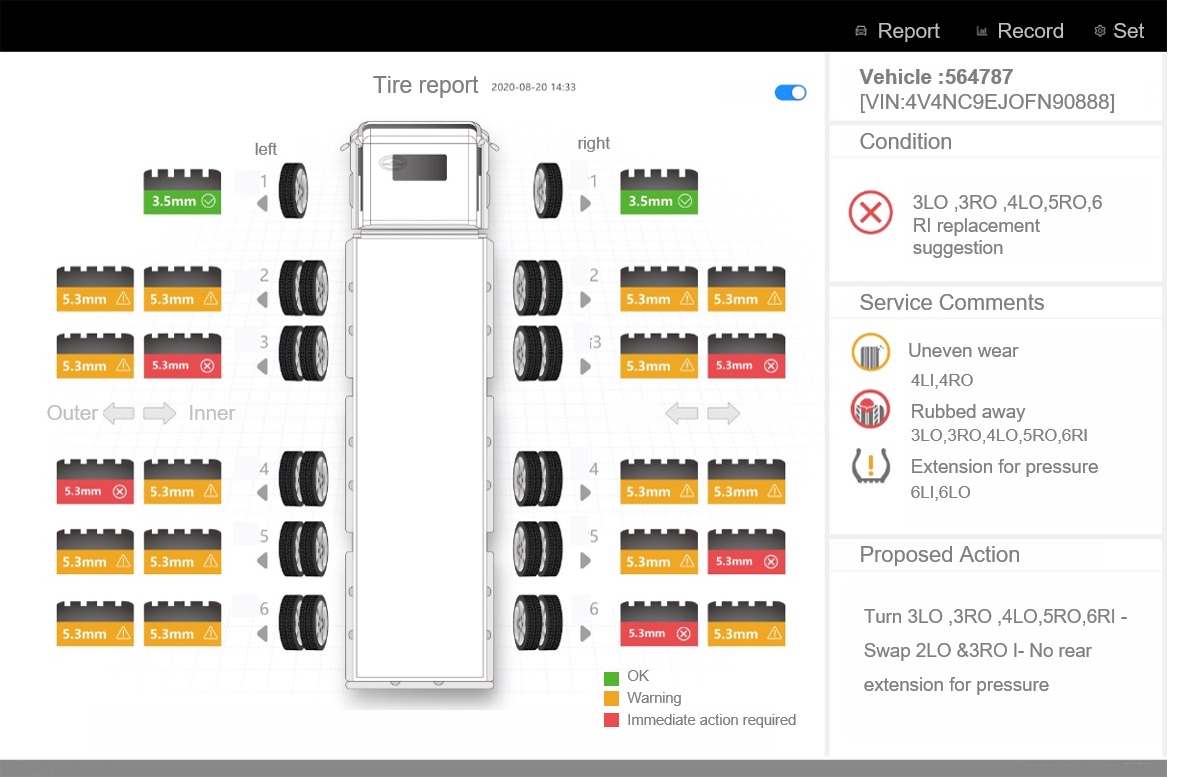
Keep records traceable across sites
Add sidewall coverage where risk requires it
Verify the workflow before signing
Where Elscope Vision fits
Manual and automated fleet tire inspection
Aspect Manual tread check Automated drive-over scanning Coverage per inspection Inspector-selected spot readings All grooves of each tire in one pass Vehicle scope Depends on access, tool, and inspection procedure Multi-wheel, multi-axle trucks in a drive-over pass Published accuracy Depends on the hand tool used 0.1 mm for passenger-car and handheld configurations; 0.3 mm for the commercial-vehicle configuration Output Readings require manual recording Digital tire diagnostics report with replacement alerts Follow-up Maintenance context must be added by the inspector Findings and suggested actions can be reviewed in the report FAQ
It depends on the configuration. Elscope Vision publishes 0.1 mm accuracy for its passenger-car and handheld tread scanners, while the current commercial-vehicle brochure lists 0.3 mm for the commercial-vehicle configuration.
The LUBAN MAX drive-over scanner reads all grooves of each tire in a single non-stopping pass and supports multi-wheel, multi-axle trucks.
No. It raises replacement alerts and alignment suggestions from measured wear, while replacement, rotation, and alignment decisions remain with the maintenance team under its configured policy.
Data from drive-through and handheld tread scanners can be collected into one cloud account. Buyers should confirm export, API availability, retention, permissions, and multi-site reporting for their deployment.
Yes. A separate tire sidewall scanner module adds sidewall and wheel defect checks and reads tire brand, model, and age.Score the scanner against a real fleet week
Let's Discuss Your Inspection Needs
We offer professional consultation services
Address : NO. 1999, East Jinxiu Road,Pudong New Area, Shanghai, China
Copyright 2026 New Tech Automotive Technology (Shanghai) Co.,Ltd. All Rights Reserved Information Security
Follow Us


Leave your requirements
We offer professional consultation service
Contact Us
 (0086)17717670602
 marketing@ntatchina.com
 8617717670602
Follow Us
Address : NO. 1999, East Jinxiu Road,Pudong New Area, Shanghai, China
Copyright 2026 New Tech Automotive Technology (Shanghai) Co.,Ltd. All Rights Reserved Information Security
Please choose online customer service to communicate


