
Autor: NTA Time: 2026-07-26 11:27:22 Click:
A defensible benchmark freezes the evaluation unit, matching rule, labels, model version, and threshold before scoring, then reports precision and recall with confusion counts and uncertainty for each relevant damage stratum.
A polished demonstration can hide disagreement about what counts as damage, where it begins, and whether a detection matches it. If those rules change after predictions are visible, the resulting score cannot support a procurement or acceptance decision. A useful benchmark therefore tests a frozen system against independently reviewed evidence, not against impressions from a few selected vehicles. The method below defines the evaluation unit, ground truth, sample, metrics, strata, reviewer agreement, uncertainty, and final read-back. A defensible AI damage detection accuracy benchmark measures agreement between frozen, adjudicated human labels and frozen model predictions under a matching rule written before scoring. It reports true positives, false positives, and false negatives first, then calculates precision and recall separately for every decision-relevant stratum. The result describes the tested sample and configuration; it is not a universal accuracy claim. Elscope Vision identifies exterior defects and produces a report that marks defect locations. Those outputs can be benchmarked, but their performance depends on the inspection scenario, capture conditions, label policy, model version, and operating threshold. The buyer should own the protocol and retain the raw evidence. Start by defining one opportunity for the system to be right or wrong. A practical unit may be a damage instance, a body panel, or a fixed image region. Do not mix units within one headline metric. Next, define how a prediction matches a label. The rule should state the permitted location overlap or distance, compatible damage classes, confidence threshold, and treatment of duplicate predictions. A prediction that satisfies the frozen rule is a true positive. An unmatched prediction is a false positive, and an unmatched ground-truth instance is a false negative. True negatives require special care because exterior surfaces contain an effectively unlimited number of possible non-damage locations. Report them only when the protocol defines a finite negative unit, such as a fixed panel grid. Otherwise, avoid a blended accuracy score and use precision and recall. Ground truth is a controlled reference, not one person's opinion. Write an annotation handbook with damage classes, size boundaries, location rules, exclusions, and examples before selecting the scored sample. Train reviewers on separate material, then freeze the handbook. Use at least two qualified reviewers who label independently and cannot see model output. Preserve their original files, route disagreements to a named adjudicator, and record the adjudication reason. Freeze the final labels before registering predictions. This prevents the model from influencing what humans later decide was present. Draw a holdout sample that was not used to train the model, tune its threshold, or refine the matching rule. Random selection reduces collection bias, but random selection alone may leave rare yet important conditions too thin for a decision. Stratify the sample using conditions that can change detection difficulty: • damage class and buyer-defined size band • body panel, material, finish, and color range • clean, wet, dusty, reflective, or otherwise in-scope surface condition • vehicle type and the lane or capture configuration being accepted Record the sampling frame, selection method, exclusions, and exclusion reasons. NIST notes that few statistical techniques can repair a non-representative sample after collection. If a condition is outside scope, declare that boundary instead of silently removing difficult cases. Scikit-learn's metric reference defines precision as TP divided by TP plus FP, and recall as TP divided by TP plus FN. Precision answers how often reported damage matched ground truth. Recall answers how much labeled damage the system found. Always publish the integer counts with each derived metric. A summary score may help comparison, but it must not replace the component counts and the operating threshold used to produce them. A single pooled result can conceal weak performance on small or low-contrast damage. Define damage-size bands in physical units when measurement is reliable, or with a documented annotation rule when it is not. Freeze the boundaries before labeling. Report precision, recall, counts, and uncertainty for each size band and damage class. If a band contains too few labeled instances to support a decision, mark it inconclusive and collect more data. Do not merge it into a favorable aggregate after seeing the result. Elscope Vision should be evaluated against the same buyer-owned strata used for every candidate system. Agreement reveals whether the reference standard is stable enough to support model scoring. For categorical labels, report raw agreement together with a chance-corrected coefficient and the original contingency counts where practical. For continuous measurements, use an intraclass approach suited to the reviewer design. For boxes or masks, report reviewer-to-reviewer spatial overlap as well as class agreement. Precision and recall are sample proportions, so attach an interval and the sample count to each result. The NIST binomial-proportion guidance describes Wilson and exact binomial approaches, while its sample-size guidance shows why no universal minimum applies. The required sample depends on the decision threshold, desired precision, expected event rate, and stratification plan. 1. Lock the annotation handbook and train reviewers on separate examples. 2. Draw the holdout sample according to the registered stratification plan. 3. Have reviewers label independently while blinded to model output. 4. Adjudicate conflicts, preserve original labels, and freeze ground truth. 5. Register the Elscope Vision model version, confidence threshold, and matching-rule version. 6. Run the sample once and export predictions without manual editing. 7. Apply the matching script and publish TP, FP, and FN by stratum. 8. Calculate precision, recall, agreement, and uncertainty, then hold the evidence read-back. Any threshold tuning or rule change after step four creates a new experiment. Keep the original result, assign a new version, and rerun on a new untouched holdout set. No. A blended number depends on an often-undefined negative unit and on the damage mix in the sample. Precision, recall, confusion counts, and per-stratum uncertainty show buyers which error is occurring and where. Large enough to make each decision-relevant stratum conclusive under the buyer's uncertainty rule. Calculate the interval from the observed counts and add samples where it remains too wide; do not adopt an unsupported universal minimum. Qualified reviewers independent of the system under test should label while blinded to predictions, with a separate adjudication path. This separation reduces confirmation bias and leaves an auditable record of genuine disagreement. Not by itself. NIST AI 800-3 distinguishes performance on a fixed benchmark from generalized performance across similar future items. Deployment claims therefore require monitoring data that documents how live conditions differ from the scored set. Require the supplier to deliver the sample manifest, annotation handbook, original reviewer labels, adjudicated ground truth, model and threshold identifiers, raw prediction export, matching script version, matched-event log, confusion counts, metric calculations, uncertainty output, exclusions, and retest rules. During read-back, ask the supplier to restate the evaluation unit, matching rule, damage strata, and threshold. Your team should confirm that each matches the frozen protocol before accepting the result. To review this protocol against an Elscope Vision configuration, contact the technical team with your own damage-size bands, operating conditions, and evidence format. Keep the labels, thresholds, and acceptance decision under buyer control.What A Defensible Benchmark Measures

Define The Evaluation Unit And Matching Rule
Build Ground Truth Before Scoring
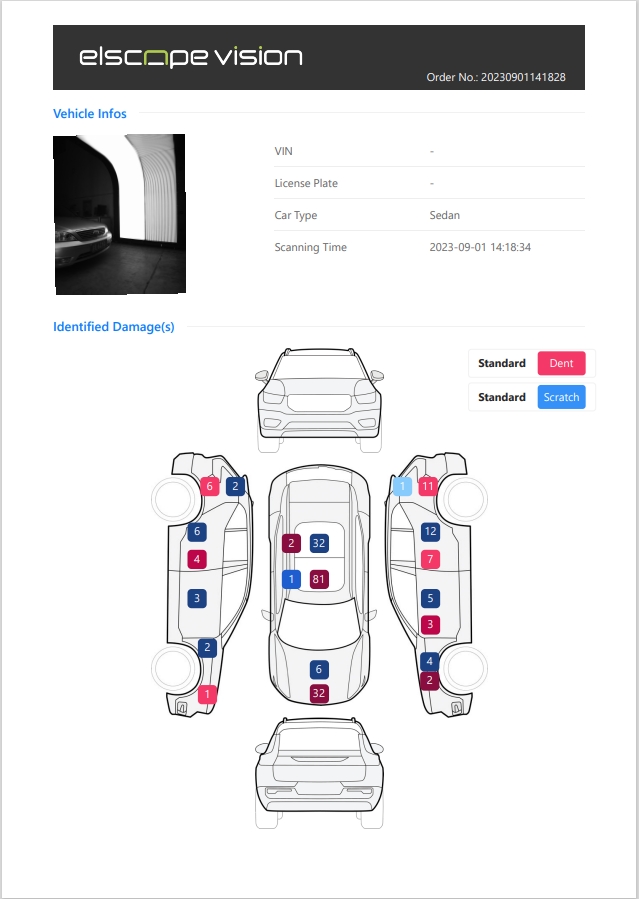
Sample A Holdout Set Across Operating Conditions
Report Precision Recall And Confusion Counts
Measure Calculation or unit Evidence required Interpretation limit Precision TP / (TP + FP) Frozen labels, prediction export, matching-rule version Does not describe missed damage Recall TP / (TP + FN) Complete labels for in-scope damage Applies to the sampled conditions F-score Harmonic summary of precision and recall Both component metrics and counts Can hide which error dominates Confusion counts TP, FP, and FN as integers Matched prediction-to-label log TN is undefined without a finite negative unit Reviewer agreement Raw agreement plus a suitable agreement coefficient Independent pre-adjudication labels Raw agreement alone can overstate consistency Uncertainty interval Method and interval for each reported proportion Numerator, denominator, and stratum size Thin strata produce wider uncertainty Separate Damage Size Strata
Measure Reviewer Agreement And Uncertainty
Run The Scored Benchmark In Sequence
Buyer Questions On Benchmark Design
Can One Accuracy Number Describe Damage Detection
How Large Should The Benchmark Sample Be
Who Should Build The Ground Truth
Does A Strong Fixed Benchmark Predict Live Performance
Evidence Package And Read-Back
Let's Discuss Your Inspection Needs
We offer professional consultation services
Address : NO. 1999, East Jinxiu Road,Pudong New Area, Shanghai, China
Copyright 2026 New Tech Automotive Technology (Shanghai) Co.,Ltd. All Rights Reserved Information Security
Follow Us


Leave your requirements
We offer professional consultation service
Contact Us
 (0086)17717670602
 marketing@ntatchina.com
 8617717670602
Follow Us
Address : NO. 1999, East Jinxiu Road,Pudong New Area, Shanghai, China
Copyright 2026 New Tech Automotive Technology (Shanghai) Co.,Ltd. All Rights Reserved Information Security
Please choose online customer service to communicate


