
Autor: NTA Time: 2026-07-25 08:30:16 Click:
Logistics operators document vehicle condition by creating a standardized, identity-bound baseline before transport, repeating the same capture at delivery, comparing the two records, and routing material differences to a human reviewer.
A receiving team finds a new scratch after a vehicle has passed through several yards, carriers, and transfer points. Without a consistent origin record, the later review depends on scattered photos and incomplete notes. The operational problem is not simply taking more pictures. It is creating two comparable records that show the same vehicle, the same areas, and the context of each handoff. This article explains the baseline, repeat-capture, comparison, review, and integration decisions that make those records useful. Logistics companies document vehicle condition before and after transport by creating a standardized pre-transport baseline tied to vehicle identity, time, and location. They repeat the same capture at delivery, compare the two evidence sets, and send material differences to a named human reviewer. Four requirements make that process reviewable: • Identity binding connects every image, finding, and note to the correct vehicle and inspection event. • Repeatable coverage captures the same panels and configured inspection areas at both checkpoints. • Structured damage mapping records an exception by location, type, and severity instead of relying only on free text. • Controlled retrieval lets authorized reviewers open the origin and destination records together. Elscope Vision supports this workflow with configured inspection lanes that can produce consistent image capture and digital condition records. The exact evidence available depends on the modules installed and the operating process around them. The origin inspection establishes what the operation knew at the start of the move. It should identify the vehicle, identify the checkpoint, and preserve enough visual coverage for a later reviewer to inspect the relevant areas. A practical baseline normally includes: • A verified vehicle identifier, such as the VIN used by the operator's approved process. • The inspection event ID, date, time, location, and workflow stage. • The configured image set and any measurements produced by installed modules. • Existing exceptions mapped to a body area or component. • Capture-quality or exception notes when evidence is incomplete. • The operator or system status needed by the site's review process. These are workflow requirements, not a universal legal record. Each operator should reconcile them with its current customer instructions, contracts, and applicable procedures. Before-and-after comparison works only when the destination record is comparable with the origin record. A different camera pattern, missing panel, or unmatched vehicle identifier can create uncertainty even when both inspections contain many images. The operational sequence should stay stable: 1. Verify the vehicle against the intended inspection event. 2. Capture the same configured exterior, underbody, or tire coverage used at origin. 3. Record the destination time, location, and handoff stage. 4. Map visible exceptions to standardized vehicle areas. 5. Compare the destination evidence with the origin baseline. 6. Route new or changed findings to a human reviewer. 7. Record the review decision, supporting evidence, and any follow-up action. The comparison should identify differences, not decide why a difference exists. Cause, responsibility, repair scope, and claim handling remain separate human and business decisions. The AIAG finished vehicle logistics program and the ECG description of AIAG damage codes show why standardized location, type, and severity fields matter. They give different parties a common structure for describing vehicle exceptions across transport handoffs. Operators should use the current version of the applicable customer or industry guidance. A field list from an older manual should not be treated as a universal reporting deadline, retention rule, or liability standard. In this workflow, chain of custody means an operational trail of inspection events, custody changes, and review actions. It does not by itself prove causation or assign legal responsibility. The trail is stronger when each handoff creates a new checkpoint record without overwriting the earlier one. An authorized reviewer should be able to see which evidence came from origin, which came from destination, and which person or system recorded the final review decision. Any correction should remain distinguishable from the original capture. That structure also helps with exceptions. If a scan is incomplete, the record should show that the required coverage was not available and route the vehicle for a rescan or manual follow-up. An incomplete pass should not silently appear as a clean result. Automated capture and AI-assisted recognition can organize evidence and flag candidate differences. A before-and-after comparison alone cannot establish when or how damage occurred, whether an item falls within a contract, or how a claim should be resolved. The NIST AI Risk Management Framework Core emphasizes documentation, defined human oversight, context-specific evaluation, and ongoing monitoring. Applied here, that means the logistics workflow should name the reviewer, define what triggers escalation, preserve the source evidence, and track overrides or rescan decisions. Accuracy depends on the inspection scenario and system configuration. Human reviewers should inspect material findings in context and apply the operator's current procedures. The official Elscope Vision arch scanner page describes automatic non-stopping image capture, body-defect location marking, API docking, local server deployment, and remote data access and traceability. Those capabilities can support a logistics evidence workflow, but they do not define a complete deployment on their own. Coverage depends on the selected configuration. A body-focused lane does not automatically produce underbody or tire evidence. Report fields, access controls, retention settings, export formats, and integration behavior should be demonstrated against the buyer's actual workflow before approval. Procurement teams should ask: • Which identifiers and event fields can the system receive and return? • Can an authorized reviewer retrieve both checkpoint records from one case? • Which images and mapped findings are included in the report and export? • What happens when capture quality is insufficient or the records do not match? • How are human decisions, corrections, and rescans preserved? No. Automated capture can support the required record with repeatable images and structured findings. The customer's current instructions and the operator's approved procedure still define what must be inspected and reported. Both records need the same vehicle identity, comparable coverage, checkpoint context, and retrievable source evidence. The comparison then shows what changed between the two records for a reviewer to assess. No. An AI finding can flag a candidate difference and link it to supporting evidence. A human reviewer applies the relevant operating procedure, contract, and claim process. Elscope Vision's official page states that the arch scanner supports API docking and local server deployment. Buyers should still validate the exact fields, formats, permissions, error handling, and retrieval process for their selected configuration. The useful record is the one an authorized reviewer can reopen after the vehicle has left the checkpoint and still understand what was captured, what changed, and how the exception was handled. Contact the Elscope Vision team to test a proposed lane configuration with your own vehicles, checkpoint fields, and review workflow.Create a baseline, repeat it, and compare the records

Build the pre-transport baseline before the vehicle moves
Repeat the same capture at the destination
Standard fields make differences easier to review
Record group Minimum operational content Review purpose Vehicle identity approved vehicle identifier and inspection event ID confirms that both records belong to the same vehicle and movement Checkpoint context date, time, location, and handoff stage places each record in the transport sequence Capture evidence configured images, measurements, and capture-quality status shows what the system actually observed Damage map body area or component, exception type, severity band, and supporting image makes origin and destination findings comparable Review record reviewer, decision, evidence reference, and exception note preserves how a flagged difference was handled Export reference report version, export time, and destination system when used helps teams retrieve the same record later 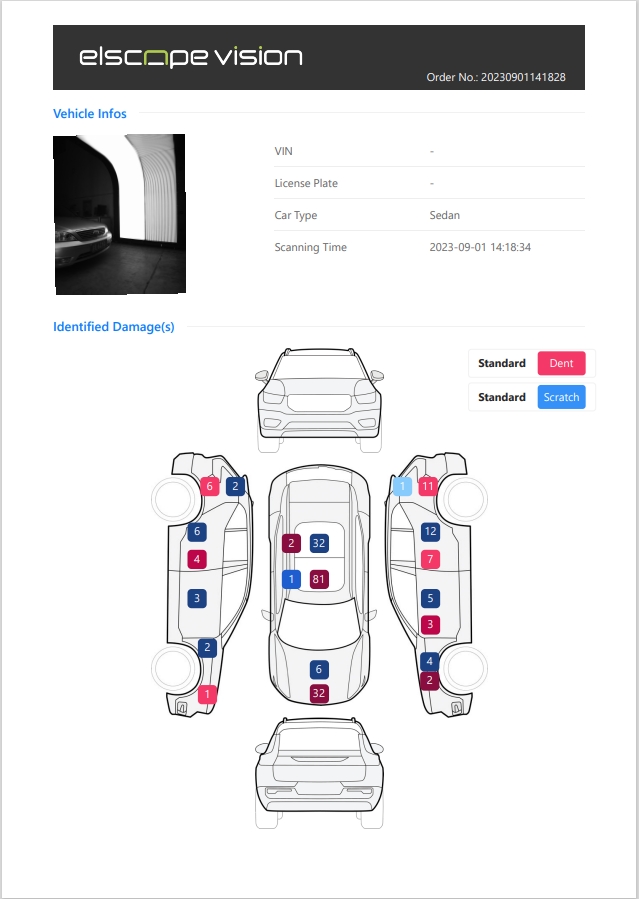
Treat chain of custody as a documented handoff trail
AI highlights differences while people adjudicate them
Match the Elscope Vision lane to the required evidence
Common questions
Does automated capture replace the required handoff inspection?
What makes a before-and-after comparison useful?
Can an AI finding determine responsibility for transport damage?
Can the records connect to an existing yard or claims system?
Make the next handoff easier to review
Let's Discuss Your Inspection Needs
We offer professional consultation services
Address : NO. 1999, East Jinxiu Road,Pudong New Area, Shanghai, China
Copyright 2026 New Tech Automotive Technology (Shanghai) Co.,Ltd. All Rights Reserved Information Security
Follow Us


Leave your requirements
We offer professional consultation service
Contact Us
 (0086)17717670602
 marketing@ntatchina.com
 8617717670602
Follow Us
Address : NO. 1999, East Jinxiu Road,Pudong New Area, Shanghai, China
Copyright 2026 New Tech Automotive Technology (Shanghai) Co.,Ltd. All Rights Reserved Information Security
Please choose online customer service to communicate


