
Autor: NTA Time: 2026-08-20 18:29:44 Click:
Defines the evidence, test sequence, thresholds, and sign-off controls a PTI station should establish before commissioning an underbody inspection lane.
Many PTI stations commission new equipment by confirming delivery, running a few vehicles, and signing off. Problems can appear later when image quality changes with vehicle speed, a supported finding type is missed in a real lane, or inspection data does not reach the receiving system correctly. A short demonstration cannot establish operational readiness. This article explains the evidence categories, test sequence, acceptance criteria, and sign-off records to collect before an automated underbody inspection lane goes live. A credible go-live decision needs documented evidence across five areas: site readiness, image quality under varied conditions, recognition testing for supported finding categories, data-path integrity, and operator readiness for normal and failure modes. The station must define the pass or fail thresholds. The equipment supplies capture, image processing, supported AI categories, local data features, and APIs. Acceptance testing proves whether those capabilities meet the station's requirements in its lane, with its vehicle mix and operating procedure. Elscope Vision's TOTA PRO underbody scanner provides 4K underbody imaging, adaptive matching to vehicle speed, and AI recognition of cracks, rust, scratches, and oil leaks. The product page also describes local data storage and API support. The acceptance plan should test each relevant capability without assuming that a product specification alone proves site readiness. The matrix separates a published capability from an operator's acceptance threshold. That distinction prevents a general brochure statement from becoming an untested site guarantee. Choose vehicles that represent the PTI site's actual mix, including different wheelbases, widths, ground clearances, underbody layouts, and surface conditions. Document why each vehicle is included. If a vehicle type falls outside the approved scope, record the exception before go-live. Recognition tests need reviewed ground truth. Use vehicles or controlled reference samples with documented conditions in each supported category: crack, rust, scratch, and oil leak. Reviewers should label the condition and location before comparing the scanner output. Keep clean examples as well, because the team must observe both missed findings and incorrectly flagged areas. Do not borrow a universal accuracy percentage. The station should define its sample design, review method, and acceptance threshold according to regulatory, safety, and operational needs. 1. Complete the site-readiness walkthrough. Confirm installation dimensions, power, network, drainage, vehicle path, protective measures, and ambient conditions against the approved design. Record every deviation and disposition. 2. Create a static image baseline. Capture a stationary reference vehicle and retain the 4K images. Have approved reviewers record sharpness, visibility, stitching or geometric artifacts, and any obscured areas. 3. Test the approved speed range. Run representative vehicles at the slow, target, and fast ends of the station's permitted range. Compare image quality and completeness across those conditions. 4. Verify vehicle coverage. Run the approved vehicle matrix and document underbody areas that cannot be captured reliably. Define the alternative inspection procedure for every exception. 5. Test each supported finding category. Compare crack, rust, scratch, and oil-leak outputs with the reviewed ground-truth set. Record misses, incorrect flags, ambiguous cases, and reviewer decisions. 6. Observe sustained lane operation. Use a station-defined time window and vehicle sequence. Record cycle times, stops, retries, queue effects, temperature or lighting changes, and operator interventions without turning the observation into a capacity promise. 7. Verify operator competence. Require each assigned operator to run capture, review, exception, escalation, and record-release steps. Keep training and authorization records. 8. Exercise failure procedures. Test network interruption, power loss, unavailable upstream systems, incomplete capture, and application restart under the approved safety plan. Record what the system preserves, what requires recovery, and what the operator must do. 9. Validate the API handoff. Send a controlled sequence of inspection events to the PTI or quality system. Verify field mapping, authentication, evidence references, timestamps, acknowledgment, retries, and reconciliation. 10. Run the retrieval audit. Retrieve images, findings, operator actions, and system logs from earlier test events. Confirm that every item is linked to the correct vehicle and scan time. 11. Close open defects. Assign an owner, due date, retest method, and acceptance authority for every failed or conditional item. 12. Sign the go-live record. Require named approvals from operations, quality, IT or integration, and the responsible equipment representative. Image quality is more than resolution. Review visibility, illumination balance, capture continuity, stitching artifacts, contamination, motion effects, and the ability to locate a finding on the vehicle. Test after the lane has been running, not only at a clean cold start. Dirt, water, vibration, temperature, and repeated vehicle passes may change the operating environment. Record the cleaning and maintenance state for every sample so later reviewers can reproduce the conditions. Keep a small set of approved reference images. Operators can use them during daily checks to identify drift before it affects a full shift. The scanner output is one input to acceptance, not the decision itself. For each tested condition, retain the ground-truth label, source image, system finding, confidence or review state where available, reviewer disposition, and reason for disagreement. Calculate results only within the defined test set and report the sample size. Do not generalize a small site test into a universal product accuracy claim. If performance differs by vehicle type, lighting condition, contamination, or defect presentation, record the segment rather than averaging it away. Acceptance may be conditional. A station could approve the lane for certain vehicle types while requiring an alternative process for an unresolved coverage case. The scope and exception must be visible in the sign-off record. The official product page describes local data storage, secure access, traceability features, and API support. The station must still test its configured environment. For each failure scenario, document: • whether the vehicle may proceed or must stop; • whether the capture is complete, incomplete, or invalid; • which data remains available after recovery; • how the operator identifies and retries the event; • how duplicate or delayed API events are handled; • who approves return to service. Do not assume that local storage automatically provides backup or disaster recovery. Those controls depend on the deployed architecture, procedures, and verification tests. The final package should contain the approved matrix, vehicle list, ground truth, test evidence, raw images, reviewer notes, API logs, training records, failure-test results, open-item register, and signatures. Store it with the lane's operational records and define when retesting is required after software, hardware, site, or workflow changes. This creates a baseline for the broader annual inspection and PTI workflow. Future incidents can be compared with the conditions that were actually accepted. Which finding categories should the test include? At minimum, test the categories published for the underbody scanner: cracks, rust, scratches, and oil leaks. Add site-specific categories only if their scope and evidence are separately defined. Should the station set its own false-positive and false-negative thresholds? Yes. The station owns the acceptance threshold, sample design, and review method. The test report must show the sample size and conditions. How should variable vehicle speed be tested? Use the station's approved operating range and compare image quality and completeness at defined points within that range. Does local data storage guarantee recovery after an outage? No. Local storage is a product feature; backup, recovery, retention, and restart behavior must be validated in the deployed configuration. What should the API test prove? It should prove correct identifiers, field mapping, evidence access, authentication, acknowledgment, retry behavior, and reconciliation in the receiving system. Acceptance testing is the evidence that the installed lane meets the PTI station's written criteria. It should expose limits and exceptions before they reach daily operations. Contact Elscope Vision to review a TOTA PRO underbody-scanner acceptance plan for your vehicle mix, lane design, and integration environment.Direct Answer: Accept the Lane Only Against Written Site Criteria
Build an Acceptance Evidence Matrix
Evidence category Product-supported capability Station-defined acceptance evidence Image quality 4K underbody imagery Readability targets, representative sample images, approved reviewers Illumination and capture High-brightness illumination and line-scan capture Acceptable visibility across the capture zone and defined artifact limits Speed variation Adaptive matching to vehicle speed Approved minimum and maximum lane speeds with sample evidence Finding categories Crack, rust, scratch, and oil-leak recognition Labeled test set, review method, and pass thresholds per category Vehicle coverage Underbody capture in the installed lane Representative vehicle list and documented coverage exceptions Data handling Local storage and traceability features Retention, access, backup, and retrieval tests defined by the station Integration API support Payload map, authentication, acknowledgment, retry, and reconciliation tests Operations Scanner and review workflow Trained operators, escalation paths, and approved failure procedures 
Define the Test Vehicles and Ground Truth
Run the Acceptance Test in Sequence
Test Image Quality Under Real Lane Conditions
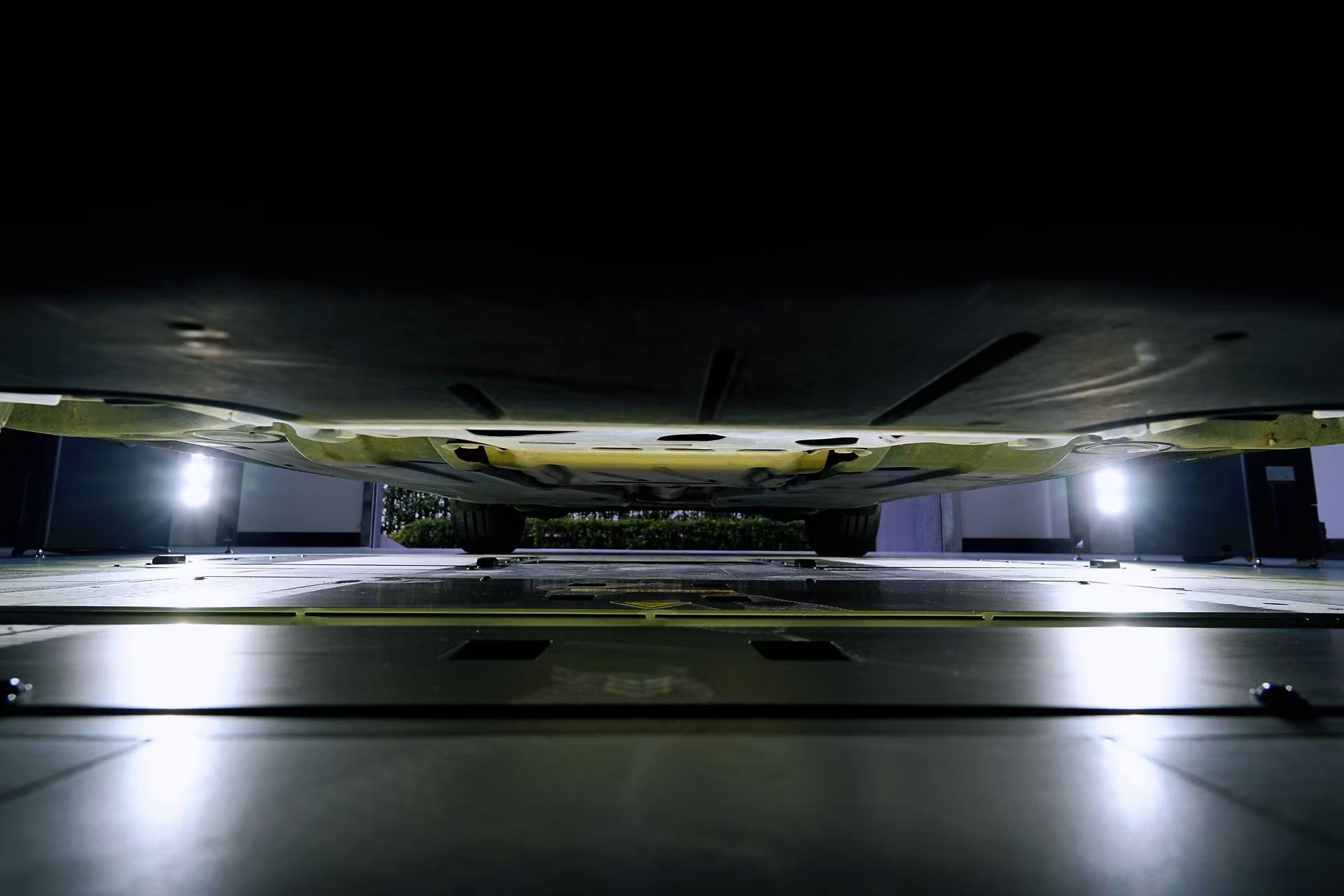
Separate Recognition Evidence From the Pass Decision
Verify Failure Behavior and Recovery
Close the Acceptance Record
FAQ
Score the Lane Before the Certificate
Let's Discuss Your Inspection Needs
We offer professional consultation services
Address : NO. 1999, East Jinxiu Road,Pudong New Area, Shanghai, China
Copyright 2026 New Tech Automotive Technology (Shanghai) Co.,Ltd. All Rights Reserved Information Security
Follow Us


Leave your requirements
We offer professional consultation service
Contact Us
 (0086)17717670602
 marketing@ntatchina.com
 8617717670602
Follow Us
Address : NO. 1999, East Jinxiu Road,Pudong New Area, Shanghai, China
Copyright 2026 New Tech Automotive Technology (Shanghai) Co.,Ltd. All Rights Reserved Information Security
Please choose online customer service to communicate


