
Autor: NTA Time: 2026-10-15 09:57:35 Click:
A decision framework for used-car retailers that combines intake inspection findings with commercial inputs to choose between retail reconditioning and wholesale disposal, with condition gates and a net value comparison.
Used-car retailers can combine intake findings and commercial criteria by running every vehicle through two tests in a fixed order. First, the used car intake inspection findings pass through condition gates that decide whether the car is a retail candidate at all. Second, retail candidates go through a net value comparison between the two paths. The comparison itself is simple. Expected retail price minus reconditioning, holding and selling costs is set against expected wholesale proceeds minus disposal and holding costs, and the car goes to retail only when the retail advantage meets or exceeds a hurdle the retailer sets in advance. The method depends on the quality of the intake record. Located, categorized findings for body, tires and underbody give the appraisal desk a defined input for each cost estimate and show which items still carry uncertainty. A finding only influences the disposal decision once it is attached to a cost category and a level of certainty. The table below maps the main inspection domains to the questions a used-car manager needs answered before pricing reconditioning. The last column matters as much as the cost itself. A cost the workshop can price from the record goes straight into the calculation, while a cost that depends on further assessment needs an allowance or a short hold before the decision. On the body side, the Dragate arch scanner shows defects in different shades of color by severity and reports the count, location and severity on each vehicle surface. That gives the estimator a panel-by-panel list rather than a general description. Official Elscope Vision sample body inspection report with dent and scratch markers on each vehicle view. For tires, the tire tread scanner measures all grooves of each tire in one pass and adds replacement alerts and wheel alignment suggestions. The tire sidewall scanner adds sidewall and wheel defect recognition and reads DOT date codes, which matters when a tire has acceptable tread but an age the retailer would not put on a retail car. Condition gates stop the team from spending appraisal time on vehicles that the retailer's own standards already exclude from retail. Each retailer writes its own gates; the examples below show the type of rule that belongs here. 1. Structural gate: a confirmed crack or heavy corrosion on a load-bearing underbody area sends the car to wholesale or to a specialist assessment before any retail estimate. 2. Fluid gate: an oil leak finding goes to a technician for source diagnosis, and the car stays out of the retail calculation until the cause and repair scope are known. 3. Retail standard gate: age, mileage, title status or vehicle history outside the retailer's retail policy routes the car to wholesale regardless of condition. 4. Reconditioning ceiling gate: if confirmed reconditioning already exceeds a set share of expected retail price, the car goes to wholesale without further estimation. 5. Program gate: if the car is a candidate for a certified or premium retail program, its findings are checked against that program's stricter standard before the general retail standard. Official Elscope Vision sample chassis inspection report with marked scratch and crack findings. The underbody scanner is what gives the structural and fluid gates evidence to work from at intake. It identifies cracks, rust, scratches and oil leaks on high-resolution underbody images, so the technician receives the marked image location to assess instead of a request to look the car over. Attaching that image to the assessment request in the retailer's workshop process lets the technician start at the flagged area. Once a car passes the gates, the decision becomes a comparison of two net values. Each input should come from a named source so that two appraisers working on similar cars arrive at similar answers. Market demand enters through Pr and Dr. All else equal, a model with long days to sale in the retailer's market carries more holding cost and a weaker retail case, even when its condition is good. The calculation uses the inputs above and keeps the uncertain reconditioning amount visible. Both net values are expected recoveries used to compare the two paths, not a full profit statement, and a single H for both paths is a simplification that can be split if costs differ. 1. Retail net = Pr minus Rc minus Rp minus (H × Dr) minus Sr. 2. Wholesale net = Pw minus Fw minus (H × Dw). 3. Retail advantage = Retail net minus Wholesale net. 4. Send the car to retail reconditioning when the retail advantage is equal to or above h; otherwise send it to wholesale. The following example is hypothetical. Money inputs are expressed as a percentage of expected retail price (Pr = 100) so the method can be adapted to any market, and time inputs are in days. Assume Rc = 4, Rp = 3, H = 0.1 per day, Dr = 45 days, Sr = 3, Pw = 86, Fw = 2, Dw = 7 days and h = 3. In this case the pending underbody allowance decides the outcome. If the technician clears the finding and Rp falls to zero, with all other inputs held constant, retail net rises to 88.5, the advantage becomes 5.2, and the car goes to retail. That sensitivity is the practical reason to separate confirmed and pending costs. A short, scheduled assessment is justified when its expected improvement in the disposal outcome exceeds the assessment fee plus the added holding cost (H multiplied by the extra days). The formula decides individual cars, while a matrix gives appraisers a fast first read and shows managers where the rules sit. The thresholds behind 'light,' 'strong' and 'weak' belong to each retailer, and demand never overrides a condition gate. Elscope Vision's Passenger Vehicle 4-in-1 Solution for used cars inspects each vehicle in a 10-second drive-through. AI analyzes the body, tires and underbody, then generates a standardized digital inspection report ready for evaluation and remarketing, as described on the used car solution page. For the disposal decision, that record supports three tasks. 1. Appraisal: the same report fields for every car let the desk apply the gates and cost categories consistently across trade-ins and purchased stock. 2. Retail path: the findings become the reconditioning work scope, and the solution's interactive 360° vehicle display, which works on mobile, desktop and tablet, supports the online listing. 3. Wholesale path: the standardized report gives the condition record that travels with the car into remarketing. The solution supports API integration and on-premises deployment, so inspection results can be connected to the retailer's appraisal or inventory system during implementation. Accuracy depends on the inspection scenario and system configuration, which is why underbody findings that drive a gate are confirmed by a technician before the car is committed. The decision rules are only as good as the assumptions behind Rc, Dr and Pw. A monthly management review that compares assumptions with outcomes keeps them current. 1. The intake reconditioning estimate is compared with the final invoiced cost for each retailed car, split by inspection domain. 2. Expected days to sale are compared with actual days to sale by model and price band, and Dr is updated where the gap persists. 3. Expected wholesale proceeds are compared with actual results, including cars sent to wholesale after a failed retail attempt. 4. Pending findings are tracked as cleared, confirmed or escalated, and the Rp allowance is adjusted for each finding type. 5. The retail hurdle h is reviewed whenever holding costs or market demand change materially. Running every vehicle through the same intake inspection keeps the decision rules consistent and gives wholesale units a condition record as well. A short drive-through capture step supports that routine when lane capacity is planned around arrival peaks. The intake policy should define a fixed assessment window and hold the car only within it. If a non-structural, non-leak assessment cannot be completed inside the window, the appraiser applies the pending-cost allowance, reruns the comparison and chooses wholesale if the advantage falls below h; structural and leak gates are still resolved first. For a live trade-in where the customer is waiting, the offer is built with the full Rp allowance and the assessment follows acquisition. In the United States, the FTC Used Car Rule requires covered dealers to post a Buyers Guide before displaying a used vehicle for sale, as set out in the FTC Dealer's Guide to the Used Car Rule. The expected cost of any warranty the retailer provides, as disclosed on that guide, belongs in Sr. The gates and the formula can be shared across the group, while Pr, Dr and Pw should come from each rooftop's own market data. Cost inputs such as Rc, H, Sr and Fw should also reflect each rooftop's actual rates, which keeps the method consistent without forcing one store's conditions onto another. A group can also add an internal transfer path, priced with the receiving rooftop's Pr and Dr plus transfer cost, before a car goes to external wholesale. Talk to the Elscope Vision team about setting up a used-car intake workflow that feeds your recondition-or-wholesale decisions with standardized inspection records. Book a consultation to discuss your lane layout, modules and system integration.Step 1: Convert intake findings into cost categories
Inspection domain What the intake record shows Cost question it raises How the estimate is built Body exterior Scratches and dents with total number, location and severity per surface Cosmetic repair, paintless dent repair or panel work Located images priced at the workshop's repair method and rates Tire tread Depth across all grooves of each tire, wear and uneven wear alerts, replacement alerts Tire replacement and possible alignment Measurements and alerts priced against the retailer's tire standard Tire sidewall and wheel Visible sidewall and wheel defects such as bulges, tire brand and DOT date code Replacement of affected tires, wheel repair Priced once the defect is confirmed at the tire bay Underbody Rust, cracks, scratches and oil leaks shown on 4K underbody images Corrosion treatment, component repair, leak diagnosis Technician assessment sets the scope before pricing Mechanical, interior, history, recalls Separate road test, interior check, vehicle history and recall lookup Mechanical repair, interior work, recall completion Priced from the results of those checks 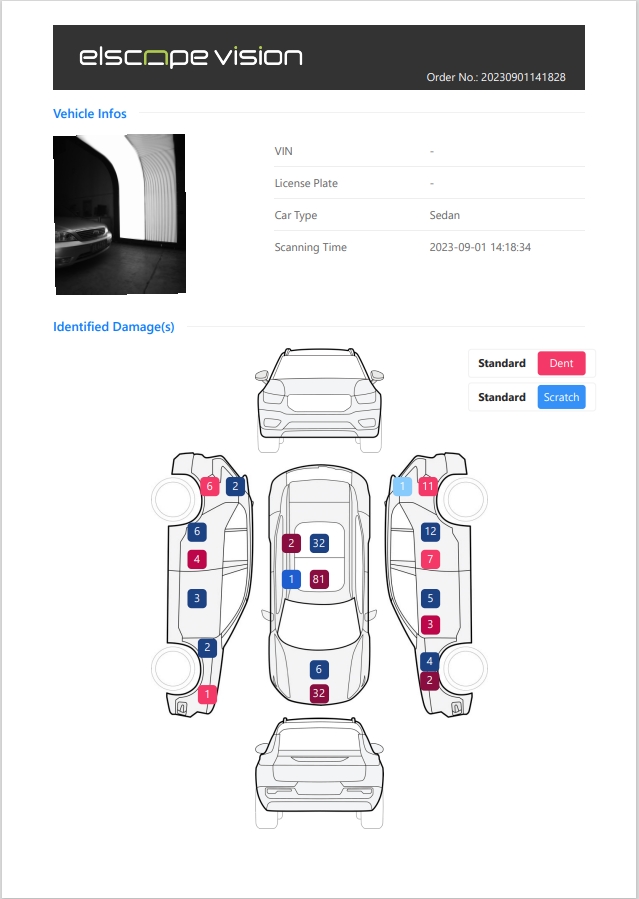
Step 2: Apply condition gates before running numbers

Step 3: Gather the commercial inputs
Input Symbol Typical source inside the retailer Expected retail price after reconditioning Pr Retail pricing tool and comparable listings in the retailer's market Confirmed reconditioning estimate Rc Estimates built from located intake findings Pending reconditioning allowance Rp Upper end of the workshop's range for findings awaiting assessment Holding cost per day H Finance, floorplan and lot costs set by the retailer; price decline is already reflected in Pr and Pw Expected days to retail sale Dr Days from the disposal decision to sale, including reconditioning time, based on the same model, age and mileage band Retail selling costs Sr Marketing, listing preparation, the expected cost of any warranty provided, program costs Expected wholesale proceeds Pw Recent wholesale results or live bids for comparable condition Wholesale disposal costs Fw Transport, auction or platform fees Expected days to wholesale Dw Days from the disposal decision to wholesale settlement in the retailer's normal cycle Retail hurdle h Minimum retail advantage the retailer requires for capital and risk Step 4: Compare the two paths with one formula
Path Calculation Net value Retail 100 − 4 − 3 − (0.1 × 45) − 3 85.5 Wholesale 86 − 2 − (0.1 × 7) 83.3 Retail advantage 85.5 − 83.3 2.2, below the hurdle of 3 A decision matrix for the appraisal desk
Intake condition profile Strong local demand, short expected days to sale Weak local demand, long expected days to sale Light body findings, tires in retail standard, clean underbody Strong retail candidate; confirm the advantage meets h Run the formula; retail only if the advantage meets h Moderate body findings and tire replacement, clean underbody Run the formula; retail if the advantage meets h Run the formula with the longer Dr; retail only if the advantage meets h Non-structural, non-leak underbody finding awaiting assessment Hold for a scheduled assessment, or price it with Rp, then run the formula Price it with Rp and run the formula; wholesale if the advantage falls below h Possible structural or leak finding Complete the gate assessment first; wholesale if confirmed beyond the retail standard Complete the gate assessment first; wholesale if confirmed beyond the retail standard Outside retail age, mileage or history standard Wholesale Wholesale Where the inspection record fits in each path
Bonus tips: keeping the thresholds calibrated
FAQ
Should every vehicle get a full intake inspection before the disposal decision?
How long should a car wait for a pending underbody assessment?
How do retail disclosure rules affect the comparison?
Can the same thresholds be used across all rooftops in a dealer group?
Set up an intake workflow that feeds the decision
Let's Discuss Your Inspection Needs
We offer professional consultation services
Address : NO. 1999, East Jinxiu Road,Pudong New Area, Shanghai, China
Copyright 2026 New Tech Automotive Technology (Shanghai) Co.,Ltd. All Rights Reserved Information Security
Follow Us


Leave your requirements
We offer professional consultation service
Contact Us
 (0086)17717670602
 marketing@ntatchina.com
 8617717670602
Follow Us
Address : NO. 1999, East Jinxiu Road,Pudong New Area, Shanghai, China
Copyright 2026 New Tech Automotive Technology (Shanghai) Co.,Ltd. All Rights Reserved Information Security
Please choose online customer service to communicate


