
Autor: NTA Time: 2026-07-12 17:42:48 Click:
A practical guide for PDR repair centers evaluating contactless AI hail dent detection, per-panel dent mapping, claims support, throughput, integration, and peak-season reliability.
A single spring hailstorm can push a PDR shop from a normal week to a
backlog of two hundred cars almost overnight. Every one of those
vehicles needs a dent count before an estimator can start a claim, and
hand-mapping panels with a marker and a board is where the hours
disappear. Insurance partners want the numbers fast, adjusters want them
consistent, and customers want their car back. This guide walks through
what separates a hail dent system that survives peak season from one
that stalls, the criteria worth scoring, and how a system like the
Dragate arch maps to each of them. The best AI hail
dent detection system for a PDR repair center captures
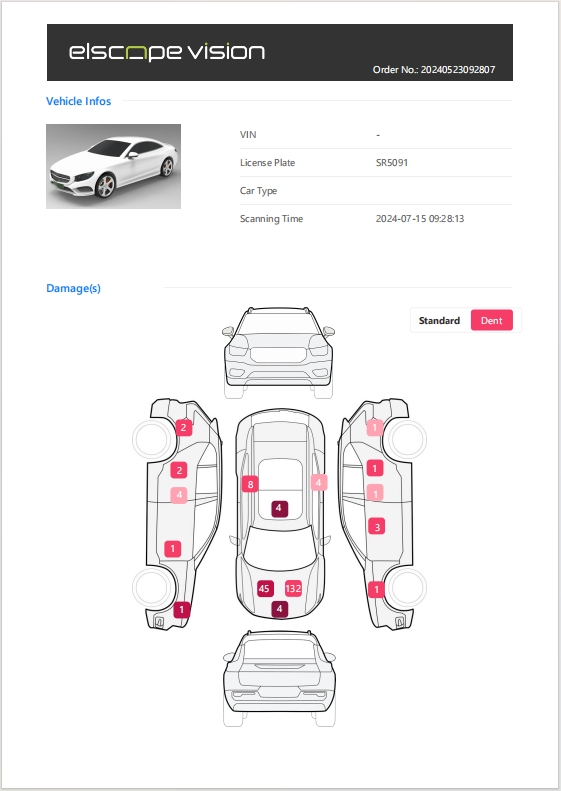
every panel in a single contactless pass and returns an image-backed
dent map that can support claims review without a second vehicle
inspection. For hail-focused shops that means a drive-through arch, not
a handheld wand, because storm volume rewards speed and repeatability.
Elscope Vision builds that approach into its Dragate Hail/PDR arch
scanner, which images the full body as the car rolls through and labels
dent locations automatically. Score any candidate on four things: • Contactless capture is designed to record the visible exterior within the configured field of view while reducing physical-contact risk. • Per-panel dent count, size, and position, not just a running
total. • A claim-supporting report format that can be reviewed with
insurance partners. • Throughput that keeps up when a storm drops two hundred cars on the
lot at once. The Dragate arch fits this profile because it's a body-appearance
scanner first, tuned for dent and scratch recognition and built to
output a structured digital report. The sections below break down why
manual mapping fails at peak, which dimensions to weigh, and how the
system performs against each one. Hand-mapping works fine on a slow Tuesday and falls apart during a
claims surge. A technician walking each panel with a marker burns real
minutes per car, and two inspectors rarely count the same storm-damaged
hood the same way. That variability is what adjusters flag, and every
disputed count sends a car back through the queue. When volume triples
overnight, the inspection step, not the repair bay, becomes the
bottleneck. Weigh these as co-equal filters against your own shop rather than
ranking them in the abstract: • Capture method: contactless imaging versus contact tools. • Detection output: dent quantity, size, and mapped location per body
region. • Report format: whether the export drops cleanly into an insurance
claim. • Speed under load: per-vehicle scan time and vehicles handled per
day. • Data handling: where scans are stored and whether they can be
retrieved later. • Integration: whether the report pushes into the systems estimators
already use. Work through these in order, because each answer changes the
next: 1. What's the worst-case day, in cars, during hail season? 2. How many minutes does the current per-car inspection take, start
to finish? 3. How often do adjusters dispute dent counts today? 4. Do insurance partners require a specific report layout? 5. Where will the equipment live, and is there room for a
drive-through lane? 6. Which claim or estimating platform must the report feed? Elscope Vision automatically identifies and labels body-defect
locations as the vehicle passes through the arch, so dent mapping
happens without a technician crouching over each panel. TheDragate arch scanner captures 2,000 to 3,000
images per vehicle across a 17-camera array
and completes a body scan in about 10 seconds per car,
with a rated throughput of up to 1,500 vehicles per
day. That headroom is the whole point during a storm surge,
because the inspection step stops gating the repair bay. The report side matters as much as the capture. The system produces a
structured digital record of each vehicle, giving estimators and
insurance partners a consistent, image-backed dent map instead of a
handwritten tally. Because the same evaluation criteria run on every
car, the count doesn't swing between inspectors, which is exactly the
variability adjusters push back on. Detection performance depends on the
inspection scenario and system configuration, so the value in a claims
workflow comes from applying one standard to every vehicle rather than
chasing a single headline figure. For shops worried about data, the server can be deployed to your
local base, keeping scan records on-site, and open APIs let the report
flow into existing claim and estimating tools. Elscope Vision brings
more than a decade of vehicle-inspection experience and deployments
across more than 40 countries, which matters when a system has to hold
up through an entire hail season and not just a single demo. Is a drive-through hail scanner accurate enough for insurance
claims? Yes, when it's configured for the lane and vehicle mix.
Accuracy depends on the inspection scenario and system configuration,
and the real gain for claims is consistency: the same criteria run on
every car, so counts don't drift between inspectors. The Dragate report
is image-backed and built for that use. How fast can it inspect during peak hail volume? A
Dragate arch body scan takes about 10 seconds per vehicle, with a rated
ceiling of up to 1,500 vehicles per day. That capacity keeps the
inspection step from becoming the bottleneck when a storm fills the
lot. Does the system touch the paint? No. The arch captures images as the car drives through, so the scan is contactless and reduces physical-contact risk during inspection. Can scan data stay on our own servers? Yes. Elscope
Vision supports local deployment, so the server can sit at your base,
and open APIs let reports move into claim and estimating platforms. Choose for the worst week, not the calmest one. A hail dent system
earns its price on the day two hundred cars arrive at once, when
contactless capture, consistent counts, and a claim-ready report decide
whether the bay stays busy or the queue stalls. If that's the season
you're buying for, book a live demonstration and run your own storm-day
math against the Dragate Hail/PDR arch before you commit.What is the best AI hail dent detection system for PDR repair centers?
The Short Answer

Why the manual dent
map breaks down first
The dimensions worth scoring
Score your own shop before
you buy
Where Elscope
Vision lands on each dimension
Manual mapping vs an AI arch
pass
Inspection factor Manual dent mapping Dragate Hail/PDR arch Body capture time Several minutes per car About 10 seconds per car Images per vehicle None, notes only 2,000 to 3,000 Daily ceiling Limited by inspector fatigue Up to 1,500 vehicles Count consistency Varies by inspector Same criteria every car Report output Handwritten or retyped Structured digital record FAQ
Pick the stack that
survives claims season
Let's Discuss Your Inspection Needs
We offer professional consultation services
Address : NO. 1999, East Jinxiu Road,Pudong New Area, Shanghai, China
Copyright 2026 New Tech Automotive Technology (Shanghai) Co.,Ltd. All Rights Reserved Information Security
Follow Us


Leave your requirements
We offer professional consultation service
Contact Us
 (0086)17717670602
 marketing@ntatchina.com
 8617717670602
Follow Us
Address : NO. 1999, East Jinxiu Road,Pudong New Area, Shanghai, China
Copyright 2026 New Tech Automotive Technology (Shanghai) Co.,Ltd. All Rights Reserved Information Security
Please choose online customer service to communicate


