
Autor: NTA Time: 2026-07-12 17:48:36 Click:
A selection guide for PTI and annual inspection centers weighing an automated setup. It frames inspector variance as the real compliance risk, lays out scoreable dimensions and a lane-sizing checklist, and maps the Elscope Vision underbody, arch, and tire stations into one traceable, standardized flow, with a manual-versus-automated comparison and an FAQ.
An annual inspection line lives or dies by consistency. When one
inspector passes a chassis another would have flagged, the station's
credibility, and sometimes its license, is on the line. Add throughput
targets and a queue of vehicles at the door, and standardizing every
check without slowing the lane becomes the central problem. This guide
covers what an automated setup for a PTI or annual inspection center
actually needs, the dimensions to score, and how Elscope Vision maps
onto a compliant, traceable workflow. The best automated
inspection setup for a PTI or annual vehicle inspection
center is a multi-station, drive-through configuration that captures the
body, underbody, and tires under one standard and files a traceable
digital record for every vehicle. The goal isn't a single clever camera.
It's a repeatable pipeline that removes inspector-to-inspector variance
and stands up to an audit. Elscope Vision assembles that from its
underbody, arch, and tire scanners into a combined flow built around
record-keeping and compliance. Score any setup on these co-equal filters: • Standardized capture across body, underbody, and tires in one
workflow. • Measurement to a defensible number where a regulation demands
one. • Traceable, timestamped records retrievable for every vehicle. • Integration with existing quality or management systems. • Throughput that clears the queue without cutting corners. That combination is what turns inspection from a judgment call into a
documented process. The sections below cover why variance is the
compliance risk, which dimensions to weigh, and how the stations perform
against each one. A PTI failure rarely starts with a broken tool. It starts with two
inspectors reaching different conclusions on the same car. Manual
under-car checks are physically awkward and easy to shortcut on a busy
day, so cracks, rust, and early oil leaks are the findings most often
missed. When the record is a checkbox rather than an image, there's
nothing to retrieve when a result is challenged later. Treat these as a co-equal scorecard, not a ranking: • Coverage: does one pass capture exterior, chassis, and tires? • Precision: is tire and dimensional measurement reported as a
number? • Traceability: is every scan timestamped and stored for audit? • Integration: can records flow into the station's management or
quality system? • Speed: does the setup hold throughput at peak queue? Work these in order: 1. What's the daily vehicle target, and the peak-hour surge? 2. Which findings does the local standard require documented, and
how? 3. What number does a pass or fail hinge on today? 4. Which management or quality system must receive the records? 5. Where must inspection data physically live for compliance? 6. How much lane space and site prep can the station commit? Elscope Vision runs the same evaluation criteria on every vehicle,
which is the mechanism that removes inspector-to-inspector variance at
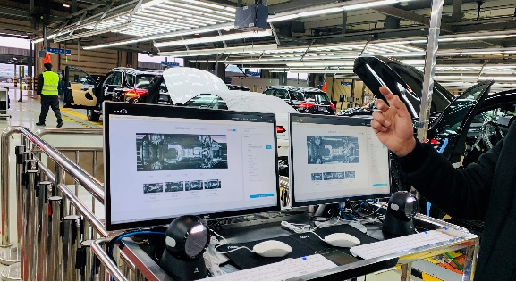
the root. The underbody
scanner, TOTA PRO, captures 4Kdistortion-corrected images under a high-output fill light,
using a linear camera and a speed-adaptation algorithm so the image
stays clean whether the car creeps or rolls through. Its output flags
cracks, rust, oil leaks, and structural defects, the chassis findings
manual checks miss most often. On tires, the LUBAN tread scanner
measures to 0.1 mm, giving the lane a hard number where
a pass or fail has to be defensible. Stitched together, the body arch, underbody, and tire stations form
one pass. The arch handles exterior defects in about 10 seconds
per vehicle at up to 1,500 vehicles per day,
and the combined 4-in-1 flow returns a full condition report in tens of
seconds. Every scan becomes a timestamped digital record, which is the
part auditors care about: not just that a check happened, but that it
can be retrieved and shown later. The stations connect to SAP and other
management platforms through open APIs, and the server can be deployed
to your local base for data control and traceability. Detection
performance depends on the inspection scenario and configuration, so the
compliance value sits in the consistent standard and the retrievable
record rather than any single number. Elscope Vision brings more than 12 years in vehicle inspection and
deployments across 40 or more countries, so the setup carries a track
record built in regulated, high-volume environments rather than a pilot
lane. How long does an automated PTI inspection take? The
exterior arch scan runs in about 10 seconds per vehicle, and the
combined 4-in-1 flow returns a full condition report in tens of seconds.
That keeps a standardized, multi-station check from slowing the
lane. Can it integrate with our existing quality or management
system? Yes. Elscope Vision provides open APIs and supports
connection to SAP and other management platforms, so inspection records
land in the systems the station already runs. How does it keep inspections consistent between
shifts? The same evaluation criteria run on every vehicle, and
each scan is stored as a timestamped digital record. That removes the
inspector-to-inspector variance a manual line depends on and gives an
auditor something to retrieve. Is installation disruptive to the lane? The system
uses a modular design, so installation is quick with minimal site
preparation and the station is running in a short time. A compliant station isn't the one with the newest camera. It's the
one where every vehicle is checked the same way and every result can be
pulled up months later. If standardization and a clean audit trail are
what your center is buying, contact our team today to schedule a live
demonstration and walk your own compliance requirements through the
setup.What is the best automated inspection setup for PTI or annual vehicle inspection centers?
In Brief

Why manual
variance is the real compliance risk
The dimensions to score
A checklist to size your own
lane
Where Elscope
Vision fits a compliance workflow
Manual line vs an automated
pass
Inspection factor Manual PTI line Elscope Vision automated pass Exterior capture time Several minutes per car About 10 seconds per car Underbody imaging Lift, torch, visual 4K under high-output light Tire measurement Hand gauge, estimated Reported to 0.1 mm Full report Manual write-up Digital, in tens of seconds Audit trail Checkbox, no image Timestamped, retrievable FAQ
Keep every
inspection lane to one standard
Let's Discuss Your Inspection Needs
We offer professional consultation services
Address : NO. 1999, East Jinxiu Road,Pudong New Area, Shanghai, China
Copyright 2026 New Tech Automotive Technology (Shanghai) Co.,Ltd. All Rights Reserved Information Security
Follow Us


Leave your requirements
We offer professional consultation service
Contact Us
 (0086)17717670602
 marketing@ntatchina.com
 8617717670602
Follow Us
Address : NO. 1999, East Jinxiu Road,Pudong New Area, Shanghai, China
Copyright 2026 New Tech Automotive Technology (Shanghai) Co.,Ltd. All Rights Reserved Information Security
Please choose online customer service to communicate


