
Autor: NTA Time: 2026-09-21 18:30:08 Click:
How to plan exterior inspections when vehicles arrive wrapped in protective film or transit covers, and what to document before and after removal.
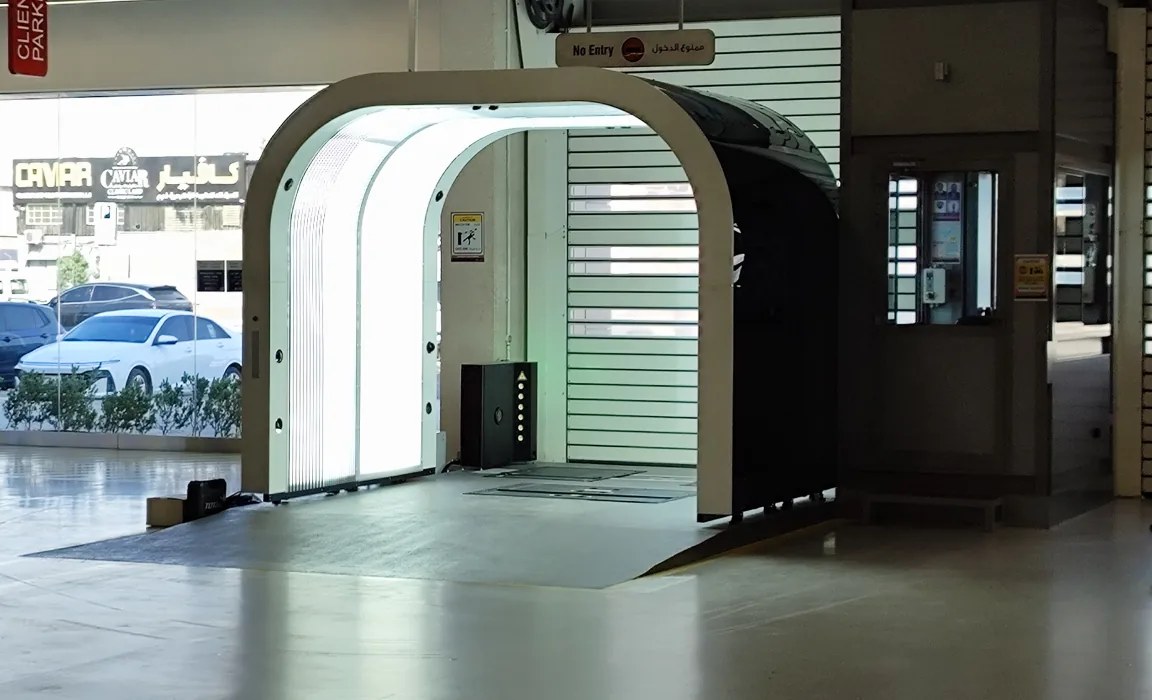
Protective coverings introduce a specific question at vehicle receipt: which surfaces are available for assessment now, and which will become accessible later? The receiving team needs to record the protective state as well as the visible condition, particularly when removal happens after the handover. That record determines how a later reviewer should interpret the inspection evidence. AI-generated scenario illustration. The inspection plan should identify exposed areas, document coverings and schedule any needed follow-up after authorized removal. The Dragate arch scanner is well suited to the visible-body capture stage, providing AI-assisted dent and scratch findings with color-coded reporting of location, severity and count. Where coverings affect the view, agree the inspection scope and operating conditions with Elscope Vision before rollout. A clean-looking image of a covering should not be treated as confirmation of the underlying paint condition. The receiving process should retain a separate note of the coverage and its implications for review. Classify coverings by whether removal is authorized at the current stage. The distinction matters more operationally than assuming every protective material should be handled the same way. Temporary transit protection. Record which areas are protected, the visible state of the material and the applicable removal instructions. Confirm who may remove it and at which handover stage. Follow the vehicle manufacturer's or responsible party's instructions for the actual material. Paint protection intended to remain in service. Treat retained PPF separately from removable transport protection. Establish what the inspection is intended to document with that film in place and confirm the suitability of the proposed scan conditions. Do not remove retained film simply to complete a routine intake check. Removable covers. Confirm whether the responsible party permits removal at the receiving location. Record their condition and the covered areas before any authorized handling. The movement plan should identify where removal takes place and how the vehicle reaches the next inspection point safely. Keep this classification with the vehicle's receiving record. It tells the next team whether a later exposed-surface assessment is planned or whether the covering will remain part of the vehicle's condition. A practical workflow breaks the exterior inspection into a pre-removal record and a post-removal scan. This is a proposed operational practice, not a native feature of any single device. Phase one: document protective state before removal. The receiving team records the covering, visible concerns, relevant vehicle identifier and handover event. These observations preserve context for any later review. Record uncertain or inaccessible areas explicitly rather than assigning them a damage-free status. Where the vehicle and coverings meet the agreed operating conditions, Dragate can supply the visible-body inspection evidence. The operator should associate the capture event with the protective-state notes in the site's record system. Do not assume the software automatically labels every covered panel or distinguishes a defect in film from one beneath it; agree the treatment of these cases during the site evaluation. Phase two: assess newly exposed surfaces after authorized removal. Record the removal event and check that the vehicle meets the agreed capture conditions. A subsequent Dragate inspection can provide body findings for review with the newly exposed surfaces available to the cameras. Preserve the earlier record and the reason for the additional inspection. Comparing the two records gives the receiving operation a before-and-after evidence pair. Damage present only in the post-removal scan, on panels that were previously covered, can be flagged for further investigation. This comparison is an operational step performed by the inspection team using whatever records management process the facility maintains. Elscope Vision's Dragate system provides an open API that supports integration with third-party platforms, though the scope and effort of any integration depend on the receiving system's architecture, authentication requirements, and data-field mapping. For a vehicle whose PPF will remain in place, agree the assessment objective before capture. The condition of the visible film and confirmation of the underlying paint are different questions. The inspection record should state which one the procedure addresses. Evaluate representative film-covered vehicles with the supplier before including them in the standard workflow. Review the resulting imagery, how visible concerns are represented and what requires separate assessment. The public product description does not establish equivalent detection performance on every film type, so operational approval should be based on the actual configuration and surface conditions. If the intended decision requires paint-level verification, assign that question to an authorized specialist and agree the method with the responsible party. Keep that assessment connected to the receiving record so later readers can distinguish it from the original optical capture. The two-phase approach has the most operational value at custody transfer points: port receiving, yard intake, dealer delivery, and auction check-in. At each handoff, the party accepting custody wants evidence of the vehicle's condition at the moment responsibility transfers. For vehicle logistics, retain the relationship between the receiving event, authorized removal and follow-up assessment. Associate each report with its own capture time in the operational record. The resulting chronology helps reviewers locate relevant evidence without treating missing findings as proof that an obscured area was undamaged. Facilities that process higher volumes benefit from building this two-phase step into their standard lane workflow rather than treating covered vehicles as exceptions. Designating a staging area for cover removal, immediately followed by a second scan pass, keeps the inspection sequence consistent and avoids situations where a vehicle's covers are removed hours or days before the follow-up scan, weakening the evidentiary link between removal and condition documentation. The operator's instruction should identify who checks coverings, who can authorize removal, where that work occurs and who reviews the subsequent findings. Test this route with representative vehicles and confirm that staff can retrieve both the condition evidence and protective-state notes. This gives Dragate a defined role in the handover process: consistent visible-body capture at the agreed inspection point, supported by the context a reviewer needs to interpret it. It also avoids an unnecessary repeat scan when no additional surface has become available for assessment. For operations that regularly receive film-wrapped or covered vehicles and want to build a structured two-phase inspection workflow, visit the Elscope Vision contact page to discuss Dragate arch scanner deployment, lane integration, and how the system's reporting and API capabilities fit your facility's existing processes.
Plan capture around the surfaces available for inspection
What Coverings Operators Typically Encounter
Planning the Two-Phase Inspection
Handling Vehicles with Permanent PPF
Connecting the Inspection Record to Logistics Handoffs
Make protective state part of the receiving instruction
Plan the covered-vehicle route before deployment
Let's Discuss Your Inspection Needs
We offer professional consultation services
Address : NO. 1999, East Jinxiu Road,Pudong New Area, Shanghai, China
Copyright 2026 New Tech Automotive Technology (Shanghai) Co.,Ltd. All Rights Reserved Information Security
Follow Us


Contact Us
 marketing@ntatchina.com
 +86-17717670602
 +86-17717670602

Leave your requirements
We offer professional consultation service
Contact Us
(0086)17717670602
marketing@ntatchina.com
8617717670602
Follow Us
Address : NO. 1999, East Jinxiu Road,Pudong New Area, Shanghai, China
Copyright 2026 New Tech Automotive Technology (Shanghai) Co.,Ltd. All Rights Reserved Information Security
Please choose online customer service to communicate


