
Autor: NTA Time: 2026-10-30 17:09:01 Click:
Pair routine PTI work with an installed 4-in-1 lane and post-storm hail surges with a containerized mobile scanner, based on two 2026 deployments.
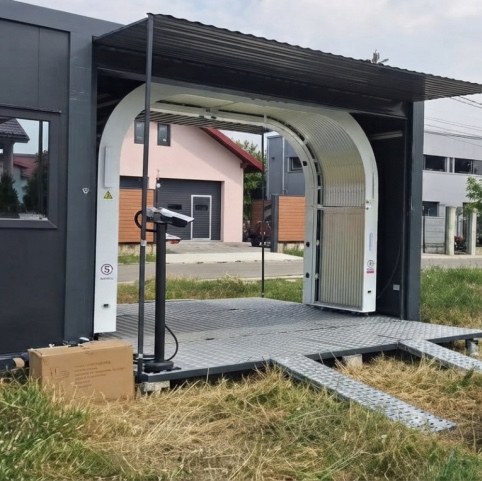
Some operators run scheduled inspections at their own centers and also have to assess storm-damaged vehicles that are parked somewhere else entirely. A buyer weighing both needs to see how an installed lane and a mobile unit are actually deployed, and the two jobs may draw on the same equipment budget. Elscope Vision has publicly documented both forms in 2026: an installed 4-in-1 lane for routine PTI work and a containerized unit for mobile hail inspection after storms. For an operator that handles both kinds of work, we recommend planning the two configurations in one program. Elscope Vision's October 28, 2026 deployment announcement covers the installed lane at a major PTI center in the Middle East. Its July 27, 2026 announcement covers the Mobile Hail Damage Scanner deployed in Romania inside a fully mobile container unit. The Middle East announcement describes a 4-in-1 system installed at a major PTI center, where vehicles arrive for routine periodic inspection. On Elscope Vision's site, that configuration appears as the 4-in-1 PTI solution, covering body, tire and underbody inspection in one drive-through. Hail creates a different kind of demand. Many damaged vehicles may need assessment at the same time, and bringing inspection to the affected area can be more practical than moving every vehicle to a fixed center. The Romania announcement describes the Mobile Hail Damage Scanner as operating inside a fully mobile container unit without permanent installation, deployable at a repair facility, storage yard, dealership or temporary disaster response site. It positions the unit for high-volume inspection during catastrophe (CAT) events, where AI identifies hail dents, records damage locations and generates standardized digital reports that support insurance documentation and repair workflows. Elscope Vision can propose the mix of lanes and container units from this information: 1. Task inventory. List the routine inspections the organization runs at its centers and the event-driven inspections it handles after storms, with the vehicle volumes for each. 2. Lane sites. Name the centers where an installed lane would carry regular traffic, with the inspection areas each center must record. 3. Container host locations. Identify the sites where a container unit would be placed and document what each can offer: a level, firm surface for the unit and its ramps, a power supply arrangement, a network connection and vehicle access. Elscope Vision then confirms the conditions the unit needs at each site. 4. Vehicle flow at each host location. Sketch how damaged vehicles arrive, pass through the unit and leave, and check where queues could form at the host site. 5. Report recipients and reviewers. Name who reviews findings before anyone acts on them: the center's inspection personnel for lane reports, and the assessor or repair technician chosen for hail work. Then list who receives each report, such as insurers, repairers, fleet managers or vehicle owners. 6. Record filing. Agree where lane reports and container reports are stored, and which vehicle reference is used to find a vehicle that both configurations have inspected. 7. Host site agreements. Settle with each host, whether a repair facility, a storage yard or a dealership, the space it provides, the hours vehicles can arrive and the on-site contact during a surge. Where different teams run the two configurations, the operator assigns ownership, operating responsibility and budget for each one inside the program. One possible split places the lane with the center that runs it and the container unit with the team that handles storm response, such as claims, fleet or repair operations. In that split, lane changes and inspection schedules stay with the center, while container deployment and host site agreements sit with the storm-response team. Running both configurations in one storm season raises two shared-resource questions before the first storm: whether the lane and the container unit will share any staff, and whether any host site shares an access road or yard with a center. Where a host site and a center do share a road or yard, the operator gives one flow priority at the shared points, with the aim of keeping vehicles booked for periodic inspection on schedule. Staffing is the other shared resource. An operator can keep lane personnel on the regular inspections and staff the container unit separately, or move people between the two. When staff do move between the two, the practical problem is keeping enough people on the lane for the day's bookings, so it is worth deciding in advance who approves a transfer and how lane cover is checked. If the lane schedule has to change, plan how owners with periodic inspection appointments are told early and offered a new slot. A short activation note can list the storm conditions that call for the container unit and the point at which it stands down. Illustrative example: an operator runs two PTI centers and has agreed a storage yard as a host site. After a hailstorm, the open question is whether both centers can keep their booked inspections while the container unit runs at the yard. Before approving any move of staff to the yard, the person who signs off transfers would compare each center's lane staffing with its bookings for the coming days. After each season, the operator can check the surge records and decide whether the plan needs adjusting, for example moving a host site if its shared entrance caused queues for vehicles booked at the center. Contact Elscope Vision with your task inventory and site list to work out how many installed lanes, which mobile hail damage scanner setup and which host sites your program needs.Match the Configuration to the Inspection Task
Inspection task Published configuration Public basis Defined in the buyer's program Routine periodic technical inspection at a center 4-in-1 system installed at the PTI center Elscope Vision announcement, October 28, 2026 Which centers get a lane and which inspection areas each center records High-volume hail damage inspection during a catastrophe event Mobile Hail Damage Scanner operating inside a fully mobile container unit, with no permanent installation Elscope Vision announcement, July 27, 2026 Where the unit is hosted, how vehicles reach it and who receives the reports Routine PTI Traffic and the Installed Lane
Post-Storm Surges and the Container Unit
Four Questions That Help Sort a Task
Question about the task (Illustrative, compiled from the two public announcements) Answer that matches the installed 4-in-1 lane Answer that matches the container unit Where are the vehicles? They come to the center as part of normal traffic They are spread across sites away from the center When does the demand arise? Ongoing, as part of the center's regular schedule Concentrated around a catastrophe event How does the inspection fit the day's work? A step in the center's regular inspection sequence A surge operation set up for the affected vehicles Who reads the report? Inspection personnel and vehicle owners Insurers, repair providers and vehicle owners Planning Both Configurations in One Program
Ownership and Budget Lines
Running the Lane and the Container Unit in the Same Storm Season
Plan the Lane and the Surge Together
Let's Discuss Your Inspection Needs
We offer professional consultation services
Address : NO. 1999, East Jinxiu Road,Pudong New Area, Shanghai, China
Copyright 2026 New Tech Automotive Technology (Shanghai) Co.,Ltd. All Rights Reserved Information Security
Follow Us


Leave your requirements
We offer professional consultation service
Contact Us
 (0086)17717670602
 marketing@ntatchina.com
 8617717670602
Follow Us
Address : NO. 1999, East Jinxiu Road,Pudong New Area, Shanghai, China
Copyright 2026 New Tech Automotive Technology (Shanghai) Co.,Ltd. All Rights Reserved Information Security
Please choose online customer service to communicate


