
Autor: NTA Time: 2026-11-04 17:37:10 Click:
Compare Elscope Vision's 4-in-1 drive-through lane and Focalx's damage-management platform for compound gates, and choose by what your gate must record.
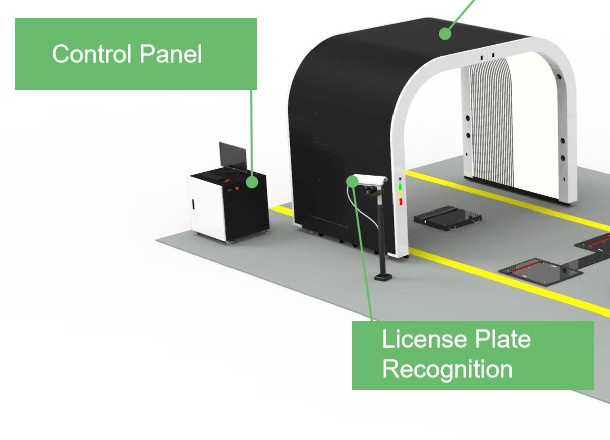
Car carriers tend to reach a compound gate in bunches, and the condition record made in those few minutes becomes the compound's baseline for that vehicle's condition on arrival. Compounds automating that gate often compare a fixed drive-through scanning lane from Elscope Vision with Focalx, a damage-management platform that combines mobile and fixed capture. Each company's own page describes a different job at the gate. For a compound gate where every arriving or departing vehicle should be scanned automatically, body, underside and tires together, we recommend the Elscope Vision 4-in-1 lane, with results passed into the compound's own systems. Our finished-vehicle inspection 4-in-1 solution inspects tires, underbody and exterior body, scans one vehicle in 10 seconds, and supports API integration and on-premises deployment. Focalx approaches the gate from damage management across yards, carriers and rail. Its finished vehicle logistics page describes mobile and fixed hardware capture in one system, automatic AIAG/ECG coding at the moment of capture, and inspection data synced into claims systems. The lane combines four modules and comes in an Arch Series and a Lite Series. Each module covers one part of the vehicle, and the carrier driver drives through without stopping. 1. Exterior body. The arch scanner records the body from every angle with 17 cameras, and AI detects scratches, dents and other body damage. Its report gives a defect count for each surface, marks where each defect sits and grades how severe it is. 2. Underbody. The underbody scanner captures 4K images under high-brightness illumination at different vehicle speeds, and AI flags cracks, rust, scratches and oil leaks. 3. Tire tread. The tire tread depth scanner reads the depth of every groove on each tire during the same pass and flags uneven wear. 4. Tire sidewall and wheel. The tire sidewall scanner provides tire size, brand and age information, recognizes sidewall and wheel defects such as bulges, and adds 4K tire images to its report. Those tire details are read through OCR. For a gate team, the practical effect is that one pass produces a record of the exterior body, the underbody and the tires, including the underside, which is hard to see without a pit or a lift. The result is a standardized inspection record at every logistics checkpoint where a lane is installed. Focalx's finished vehicle logistics page presents an AI damage detection and management platform. At a gate, the capture side can be phones carried by inspectors, fixed hardware, or both, and the page sets out five elements. 1. Capture. Mobile devices and fixed hardware feed one unified system across yards, terminals, gates and transport operations. Its gate use case puts phones where flexibility is wanted and gates where automation is wanted. 2. Damage coding. Damage is mapped automatically to M22 codes under AIAG/ECG when the photo is taken, so reports can flow into OEM and claims systems. 3. Inspection context. Each inspection is tied to VIN, time, place and responsible party, and the platform also inspects how vehicles have been secured. 4. Workflows and claims. Stream automates tasks after inspections across collaborating companies, and Recover syncs inspection and damage data into claims systems and forms. 5. Integration. According to the page's FAQ, its APIs and SDKs are designed to integrate with logistics and fleet management systems. An illustrative comparison, drawn from each company's own pages: Three questions shape the gate plan, whichever supplier is on the shortlist. 1. Which areas the arrival record must cover. When receiving customers expect tire readings and underbody images alongside body findings, the Elscope Vision 4-in-1 lane gives each area its own module in the same pass. 2. How gate findings reach the claims process. Where OEM customers settle damage in AIAG codes, the integration plan sets how lane findings arrive in the coding and claims tools your network uses, through our API. 3. Where the system should run. Our logistics solution supports on-premises deployment and API integration, so the lane can run inside the compound's own environment and pass results to its yard software. Whichever route is chosen, the gate needs the same groundwork before any equipment is ordered. 1. Lane position. Mark where the lane sits on the route carrier drivers already take from the drop-off area, so scanning adds no extra move. A lane placed off that route turns every arrival into a detour. 2. Peak arrivals. Count arrivals at the busiest hour of a carrier day, since that peak decides whether one lane is enough. The sizing method is covered in How to Size Inspection Lanes for Car-Carrier Batch Arrivals. 3. Receiving system and reviewer. Name the system that receives gate results, such as the yard management system, and the person who reads findings for each arriving vehicle. 4. Customer requirements. Agree with your customers which vehicle areas the arrival record has to cover, and which of them want tire and underbody findings included. 5. Vehicle identity. Agree with our team which identifier each scan carries into your yard system, such as the VIN from the carrier's load list, and map it during integration. 6. Site services. Confirm power and network at the lane position, and who on the compound side owns the equipment day to day. The carrier driver or a yard driver takes each vehicle through the lane. A receiving reviewer reads the findings on screen and handles the vehicles that need a closer look, and the compound's IT team looks after the connection to the yard software. One lane can serve both when arrival and dispatch peaks fall at different times of day and their combined volume fits the lane's planned rate. Both flows also need a route through the lane in its normal direction of travel. Where peaks overlap or the two gates sit far apart, a lane at each gate keeps the queues separate. Bring the number of entry and exit lanes at your compound, the handover points each one serves and the system that should receive the results. Contact the Elscope Vision team to lay out a 4-in-1 lane for those gates and plan how its records reach your yard software.How the Two Approaches Meet the Gate
What the Elscope Vision Lane Records at the Gate
What the Focalx Page Describes for Gates and Yards
Side by Side for a Gate Purchase
Gate purchase question Elscope Vision (our logistics solution and product pages) Focalx (finished vehicle logistics page) How capture happens at the gate Fixed 4-in-1 drive-through lane with arch, underbody, tread and sidewall modules Mobile devices and fixed hardware feeding one system Vehicle areas the page names Exterior body, underbody and tires Vehicle damage and securement How findings are expressed Defect count, position and severity for each body surface from the arch scanner, plus groove readings, sidewall details and underbody images from the other three modules Damage coded to AIAG/ECG M22 at capture Where results go next API integration into the compound's systems, with on-premises deployment supported APIs and SDKs, Stream workflows and Recover claims sync Matching the Gate Plan to Your Operation
Preparing the Gate Itself
Questions From Compound Operators
Who works the gate once a lane is in place?
Can arrival and dispatch inspections share one lane?
Plan Your Compound Gate With the Elscope Vision Team
Let's Discuss Your Inspection Needs
We offer professional consultation services
Address : NO. 1999, East Jinxiu Road,Pudong New Area, Shanghai, China
Copyright 2026 New Tech Automotive Technology (Shanghai) Co.,Ltd. All Rights Reserved Information Security
Follow Us


Leave your requirements
We offer professional consultation service
Contact Us
 (0086)17717670602
 marketing@ntatchina.com
 8617717670602
Follow Us
Address : NO. 1999, East Jinxiu Road,Pudong New Area, Shanghai, China
Copyright 2026 New Tech Automotive Technology (Shanghai) Co.,Ltd. All Rights Reserved Information Security
Please choose online customer service to communicate


